
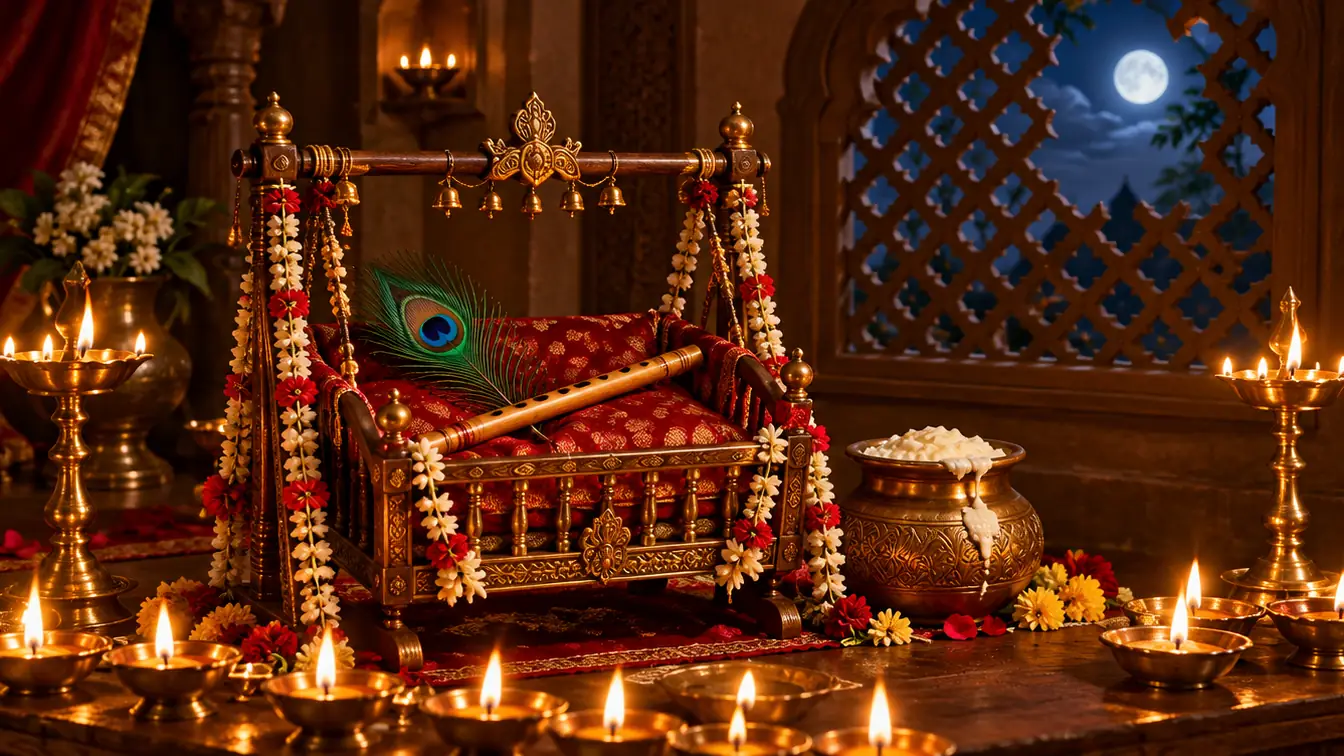
Janmashtami Midnight Timing in Central Time
Janmashtami in Fort Worth in 2027 falls on the night of Tuesday 24 August. The traditional midnight, nishita, is the middle of the night between local sunset and sunrise, and on a Central Daylight clock in Fort Worth that comes at about 1:31 am, not 12:00. The nishita window runs from about 1:09 to 1:53 am.
Key takeaways
- Krishna's birth is celebrated on the eighth lunar day of the dark half of the month (Shravana in the southern and western reckoning, Bhadrapada in the northern one), at midnight.
- In the tradition, "midnight" means nishita: the middle of the night, halfway between sunset and sunrise, and more precisely the eighth of the night's fifteen divisions.
- Temples balance tradition with families who have work the next morning.
- With young children, a practical compromise works well: a cradle ceremony at an earlier symbolic hour with the whole family, and a quieter puja at nishita for the adults who stay up.
- In vastu the northeast is the traditional zone for worship, and many families set the jhula there, facing east or north.
Families in Fort Worth who set an alarm for 11:55 pm on Janmashtami are often surprised to learn that, by the tradition's own reckoning, Krishna's midnight has not arrived yet. It comes well after one o'clock on the clock. Janmashtami in Fort Worth is a lesson in how a Central Daylight clock and a Texas longitude reshape an ancient timetable, and in why temples around the Metroplex do not always agree on the hour or the night.
Which night is Janmashtami in 2027?
Krishna's birth is celebrated on the eighth lunar day of the dark half of the month (Shravana in the southern and western reckoning, Bhadrapada in the northern one), at midnight. In 2027 that lunar day runs from about 9:55 am on Tuesday 24 August to about 8:50 am on Wednesday 25 August, Central Daylight Time. It covers the whole of Tuesday night, so the Smarta observance in Fort Worth is the night of Tuesday 24 August, with the midnight puja falling in the early hours of Wednesday by the calendar.
Why midnight is not 12:00
In the tradition, "midnight" means nishita: the middle of the night, halfway between sunset and sunrise, and more precisely the eighth of the night's fifteen divisions. Using the Naval Observatory's sunrise and sunset data method, sunset in Fort Worth on 24 August 2027 is at about 8:04 pm and sunrise the next morning at about 6:59 am. Halfway between them is about 1:31 am.
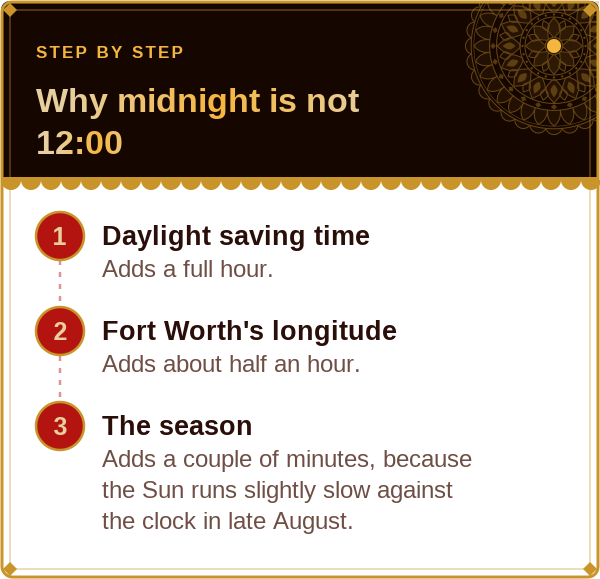
Three separate effects push it that late:
- Daylight saving time adds a full hour. In August the clocks are on Central Daylight Time, an hour ahead of the Sun. The history of daylight saving in the United States explains how that came about.
- Fort Worth's longitude adds about half an hour. Central Time is based on the meridian at 90 degrees west; Fort Worth sits at about 97 degrees west, so its solar midnight comes roughly 29 minutes later than the zone's.
- The season adds a couple of minutes, because the Sun runs slightly slow against the clock in late August.
Add them together and the middle of the night lands near 1:31 am, with the nishita window running from about 1:09 to 1:53 am. The same daylight-time shift is why birth times recorded in summer need converting, as our post on daylight saving time and birth charts explains.
How temples set their times
Temples balance tradition with families who have work the next morning. Some hold the main abhishekam and aarti at clock midnight; some follow the calculated nishita; many move the big public celebration to the nearest weekend and keep a smaller puja on the night itself. Krishna temples following Vaishnava calendars may observe a different day altogether when the lunar day falls awkwardly. Check your own temple's schedule, and do not worry if it differs from a neighbor's: each is following a recognized rule.
A midnight puja at home
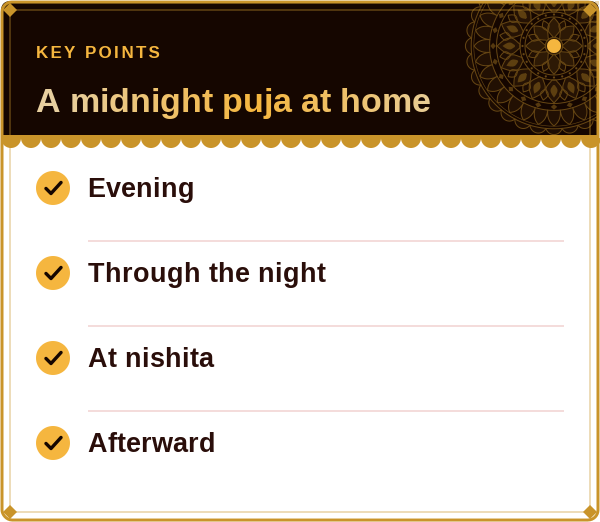
- Evening: decorate a small cradle or jhula for Bal Gopal with flowers and cloth, and prepare panchamrit, butter, curd and sweets.
- Through the night: bhajans, readings from the Bhagavata stories of Krishna's birth, or quiet chanting.
- At nishita: bathe the murti in panchamrit, dress it, place it in the cradle, rock it gently and perform aarti. Ring a bell or blow a conch to welcome the birth.
- Afterward: share prasad. Those fasting break it now or after sunrise, according to family custom; our post on fasting and its safe limits covers health cautions.
With young children, a practical compromise works well: a cradle ceremony at an earlier symbolic hour with the whole family, and a quieter puja at nishita for the adults who stay up.
Where to place the cradle
In vastu the northeast is the traditional zone for worship, and many families set the jhula there, facing east or north. In a Texas floor plan where the northeast is a garage or a laundry room, the northeast corner of the living room works just as well. A vastu consultation for a Fort Worth home can suggest a permanent spot for the prayer shelf that also suits festival setups like this one.
Rohini and the 2027 night
Krishna was born under Rohini, the fourth of the 27 lunar mansions, and the most treasured Janmashtami nights have Rohini and the eighth lunar day together at midnight. In 2027 the Moon reaches Rohini at about 2 am, a few minutes after the window closes, so it is an eighth-day-only year in Fort Worth. If nakshatras are new to you, see our guide to finding your birth nakshatra.
What the timing cannot do
A carefully calculated nishita is a way of honoring tradition precisely; it does not make a puja at another hour less sincere. If you would like festival times worked out for your household, Astrologer and Psychic Vijayram prepares them by phone, WhatsApp or video, in Central Time.
Common questions
Can we hold the midnight puja at 12:00 anyway?
Yes. Many households and temples celebrate at clock midnight because it is the hour everyone understands, and devotion at 12:00 is still devotion. If you want the traditional moment, the middle of the night in Fort Worth falls later, around 1:30 am in late August.
Why do some Krishna temples celebrate on a different day?
Smarta and Vaishnava calendars use different rules. Smarta almanacs choose the night when the eighth lunar day is running at midnight; many Vaishnava calendars weigh the lunar day at sunrise and avoid any overlap with the seventh. When the eighth falls awkwardly, the two can land a day apart.
When should we break the Janmashtami fast?
Customs differ. Some families eat prasad right after the midnight puja; others wait until after sunrise the next morning. Anyone with diabetes, a pregnancy or regular medication should eat as their doctor advises and keep the fast symbolically.
Does the Moon need to be in Rohini?
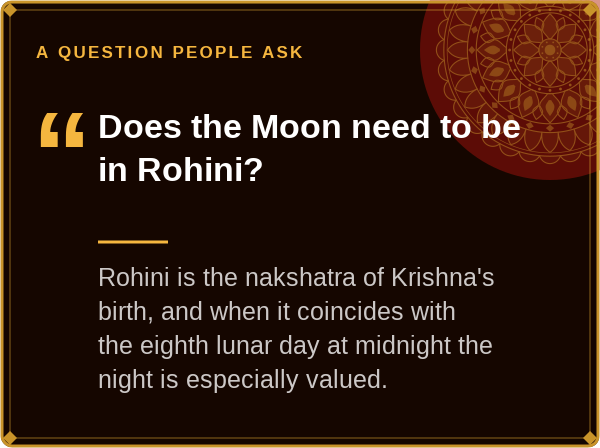
Rohini is the nakshatra of Krishna's birth, and when it coincides with the eighth lunar day at midnight the night is especially valued. It is not required. In Fort Worth in 2027 the Moon enters Rohini at about 2 am, just after the midnight window closes.
Related service
Keep reading
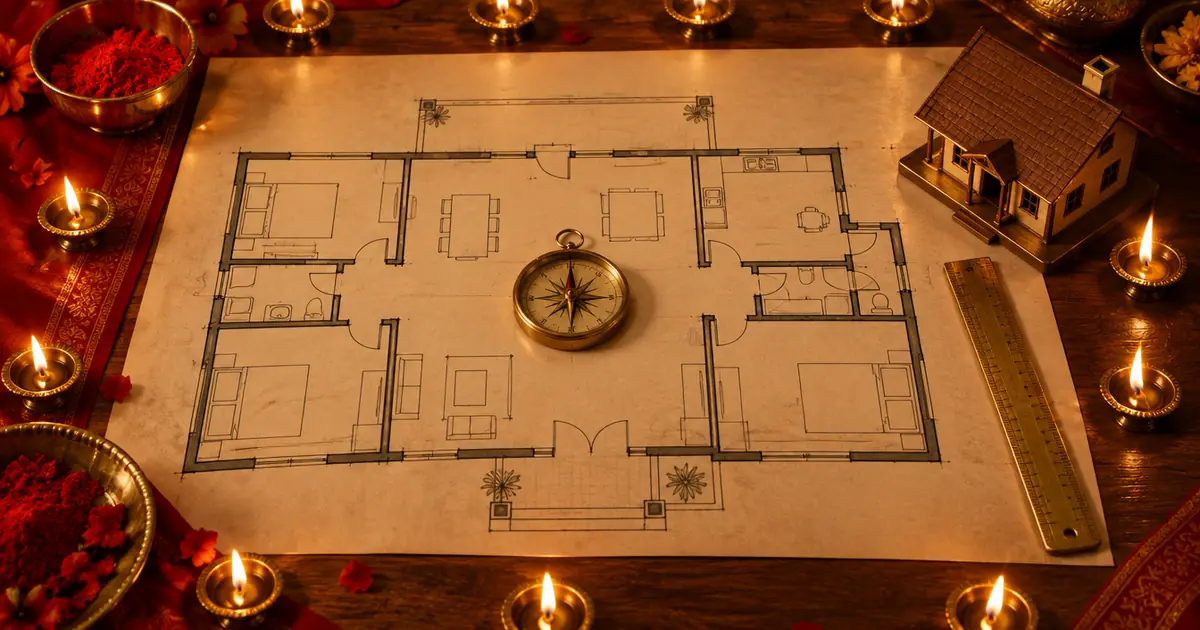
Vastu for Texas Ranch-Style and New-Build Homes
Vastu for Texas homes: applying direction-based principles to single-story ranch plans and builder floor plans common in Tarrant County, without demolition.
Read article →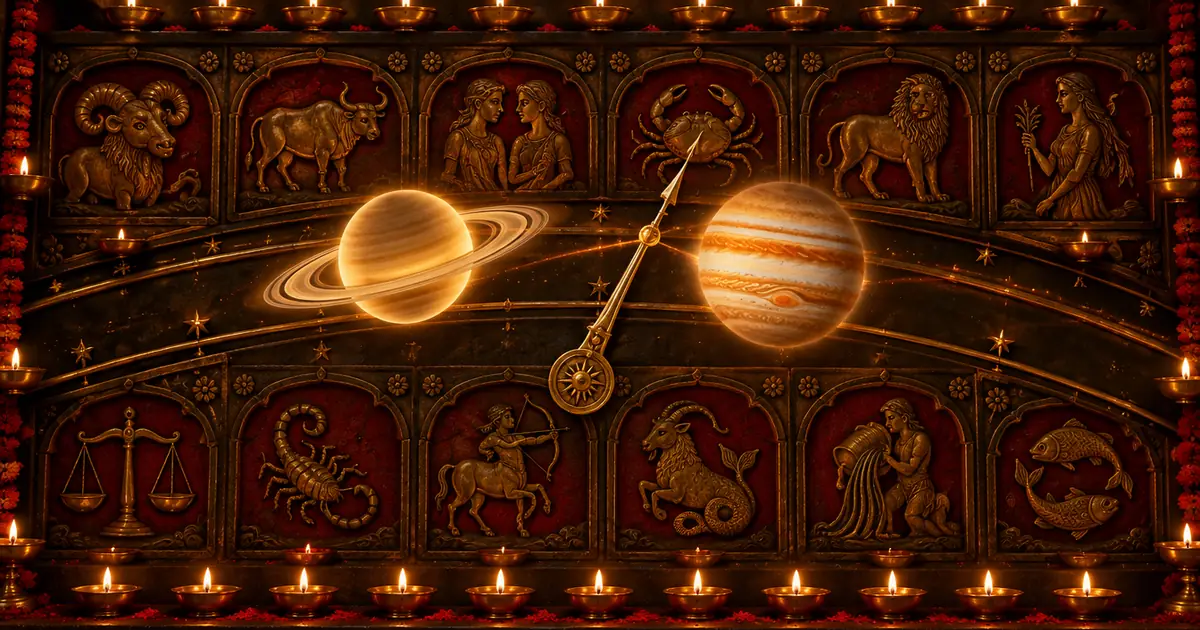
2027 Transit Dates in Central Time: Saturn and Jupiter Sign Changes
The Saturn transit 2027 date in Central Time: Saturn enters sidereal Aries on 2 June 2027. Plus Jupiter's sign changes and a calm note for each rising sign.
Read article →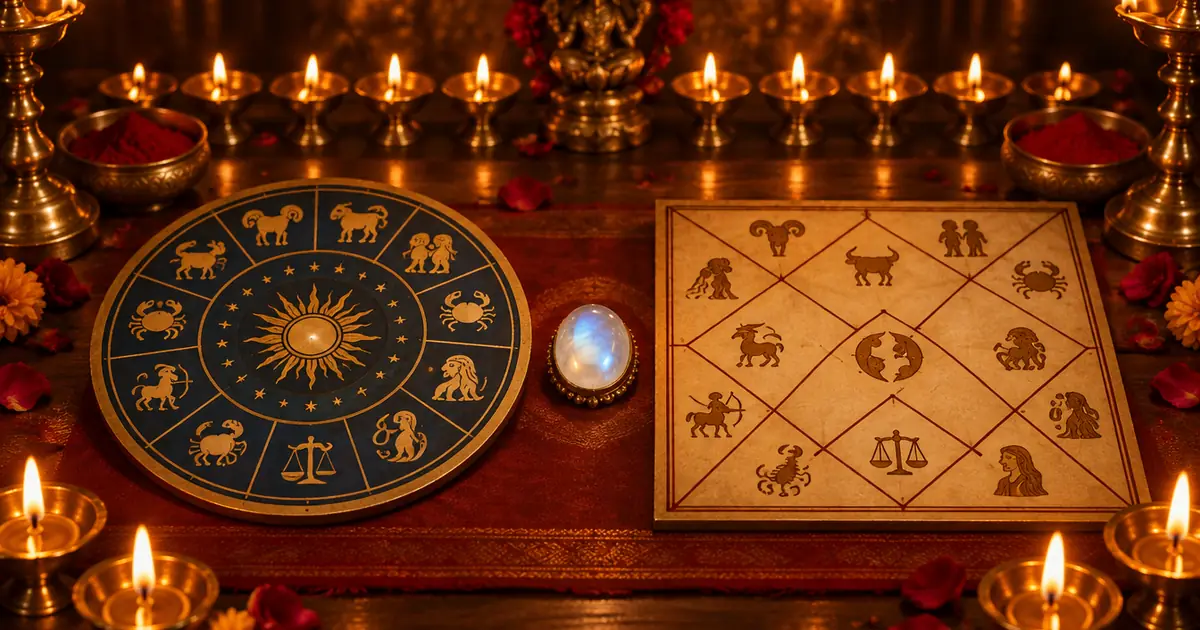
Vedic or Western? What Fort Worth Clients Ask First
Vedic vs Western astrology for Fort Worth readers who know only their sun sign: the sidereal zodiac, why your sign may shift, the Moon sign and dashas.
Read article →Quick answers
Must I stop reading Western horoscopes to see a Vedic astrologer?
No, you do not need to stop reading your Western horoscope to see a Vedic astrologer in Fort Worth. How the two zodiacs differ and why your sign may shift.
Read answer →Do I need my birth certificate for a Vedic reading?
You do not need your birth certificate for a Vedic reading in Fort Worth: date, time and place of birth matter, and a certificate simply confirms the time.
Read answer →Talk to Astrologer and Psychic Vijayram
Tell us what you are facing. If a reading is unlikely to help, you will be told that plainly.