

An Oracle Card Reflection for Fort Worth Teachers Before School
An oracle card reflection is a short daily practice: you draw one card, read its message and write a few lines about what it brings up. For Fort Worth teachers in the weeks before school, it helps set an intention and check in on energy. It is a habit of reflection, not a forecast of how the year will go.
Key takeaways
- Oracle card reading is the practice of drawing a card from a themed deck and using its image and message as a prompt for reflection.
- Research summarized by the University of Rochester Medical Center on journaling describes writing as a way to manage stress and notice patterns.
- Most oracle decks are encouraging, but some cards speak of rest, release or slowing down, which can feel unwelcome when you have forty things to do.
- Sometimes a few days of writing make it clear that you are not just tired but running on empty.
- An oracle card cannot tell you how your class will behave, how a parent conference will go or whether this year will be easier than the last.
The first weeks of August have a feel every teacher in Fort Worth knows. The classroom is half set up, the inbox is filling, training days are on the calendar, and the heat outside makes everything slower. Before the first bell, there is a short window when you can decide how you want to carry the year. An oracle card reflection is one small way to use that window: ten minutes a day, one card, a few lines in a notebook.
This practice is written for classroom teachers, but it fits anyone in a school building: counselors, aides, librarians, nurses, bus drivers, front-office staff and cafeteria crews. The start of the year asks a lot of all of them.
What is oracle card reading?
Oracle card reading is the practice of drawing a card from a themed deck and using its image and message as a prompt for reflection. Oracle decks are written by individual authors and vary widely, from nature images to single words, and they are usually gentler and more open than tarot. They sit within a much older tradition of reading cards, but most modern oracle decks are designed for encouragement rather than prediction.
That makes them a good fit for a teacher's August. You are not asking "Will this be a good year?" You are asking "What do I want to bring into this year, and what do I need to protect?"
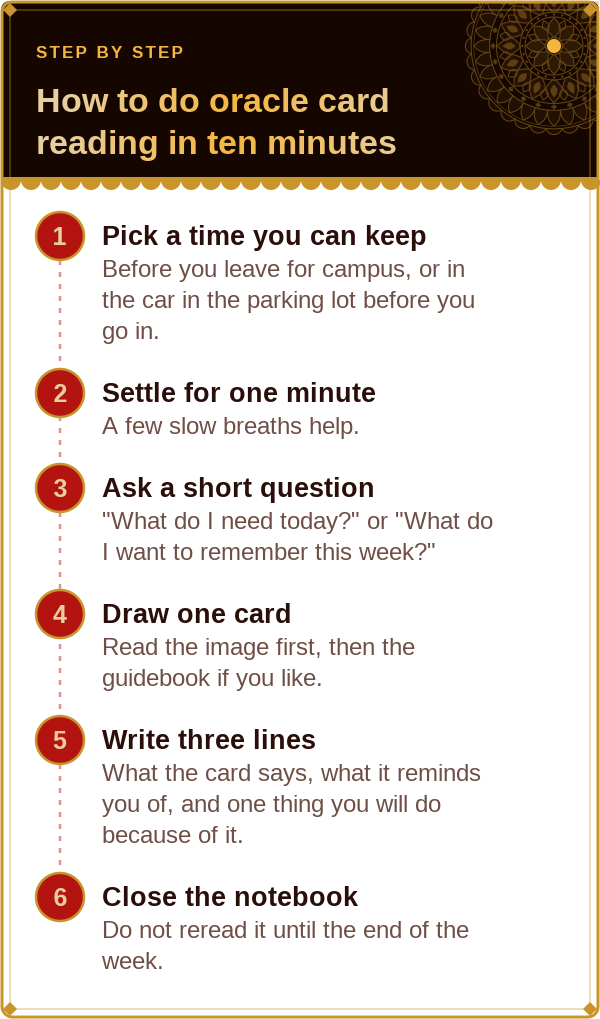
How to do oracle card reading in ten minutes
- Pick a time you can keep. Before you leave for campus, or in the car in the parking lot before you go in.
- Settle for one minute. A few slow breaths help. The short practice in simple pranayama for calm takes about that long.
- Ask a short question. "What do I need today?" or "What do I want to remember this week?"
- Draw one card. Read the image first, then the guidebook if you like.
- Write three lines. What the card says, what it reminds you of, and one thing you will do because of it.
- Close the notebook. Do not reread it until the end of the week.
Writing matters more than the card. Research summarized by the University of Rochester Medical Center on journaling describes writing as a way to manage stress and notice patterns. The card is the prompt; the notebook is where the reflection happens.
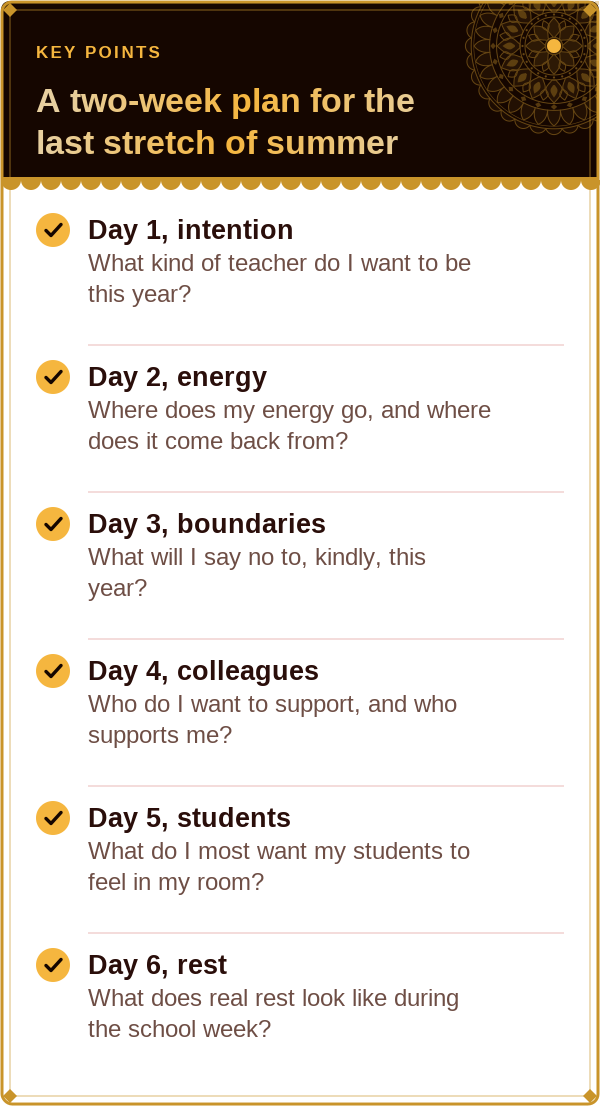
A two-week plan for the last stretch of summer
If you like structure, give each day a focus. Repeat the cycle in the second week.
- Day 1, intention: What kind of teacher do I want to be this year?
- Day 2, energy: Where does my energy go, and where does it come back from?
- Day 3, boundaries: What will I say no to, kindly, this year?
- Day 4, colleagues: Who do I want to support, and who supports me?
- Day 5, students: What do I most want my students to feel in my room?
- Day 6, rest: What does real rest look like during the school week?
- Day 7, review: Read the week's notes and circle one sentence to carry forward.
By the end of the second week you will have one or two sentences that sum up your intention. Some teachers write them on a sticky note inside the planner and look at it on hard days in October.
Reading a card that feels discouraging
Most oracle decks are encouraging, but some cards speak of rest, release or slowing down, which can feel unwelcome when you have forty things to do. Treat those cards as practical advice, not warnings. A card about rest in August may simply be pointing out that you have been setting up your room every evening for a week. A card about letting go may point to a lesson plan you love that no longer works.
If a card brings up worry about the year ahead, write the worry down and then write one thing within your control. That turns a vague fear into a step.
When the reflection shows real strain
Sometimes a few days of writing make it clear that you are not just tired but running on empty. Teaching is demanding work, and burnout is common. If you notice ongoing sleep problems, dread that does not lift, or physical symptoms, talk to your doctor or use your district's employee assistance program if it offers one. The MedlinePlus guide to stress lists signs worth taking seriously. Cards and journals can support you; they do not replace care.
Other quiet practices for a school year
If the cards help, you may like the ten-minute mantra practice for busy days, which fits the same slot in the morning, or a one-card walk on the river paths described in a Trinity Trails walking reflection. Teachers who would like a guided version can book a gentle oracle card session with Astrologer and Psychic Vijayram by phone, WhatsApp or video, or a personal mantra and meditation session for a steadier daily routine through the year.
What this practice cannot do
An oracle card cannot tell you how your class will behave, how a parent conference will go or whether this year will be easier than the last. It is a prompt for reflection that helps you set an intention and notice how you are doing. The year itself will be shaped by you, your students, your colleagues and a great many things no card can see.
Common questions
Do I need a special deck for this?
No. Any oracle or angel deck with short, readable messages works. Some teachers use a deck of plain index cards with words they choose themselves, such as patience, curiosity, rest and humor, which works just as well.
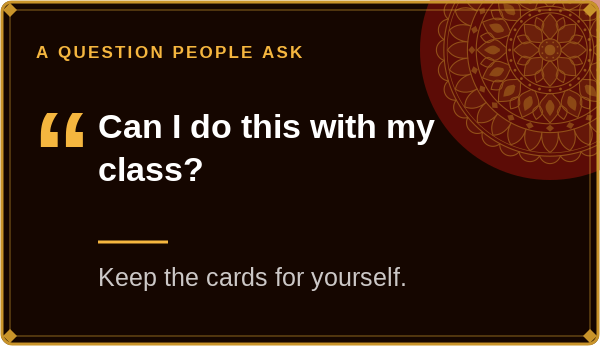
Can I do this with my class?
Keep the cards for yourself. Schools have their own policies on spiritual practices in class, and families hold different beliefs. A neutral journal prompt or a word of the day gives students something similar without the cards.
What if I draw the same card several days in a row?
Notice it and write about it. Repeated cards are usually read as a theme asking for more attention. It may simply be the part of the year you are most concerned about.
Is oracle card reading a religious practice?
Not in itself. People of many faiths, and none, use oracle cards as a prompt for reflection. If your own faith discourages card reading, the same ten minutes work with a written prompt or a short prayer instead.
Related service

Keep reading

Tarot for Small-Business Owners on Magnolia Avenue
Tarot for business owners on Magnolia Avenue and across the Near Southside: a six-card spread for staffing, pricing and growth, used as reflection only.
Read article →
The Pentacles Suit and Money Worries: A Calm Reading
Pentacles tarot meaning for money, card by card: how the suit is read for budgets, work and security, plus a calm money spread that is not financial advice.
Read article →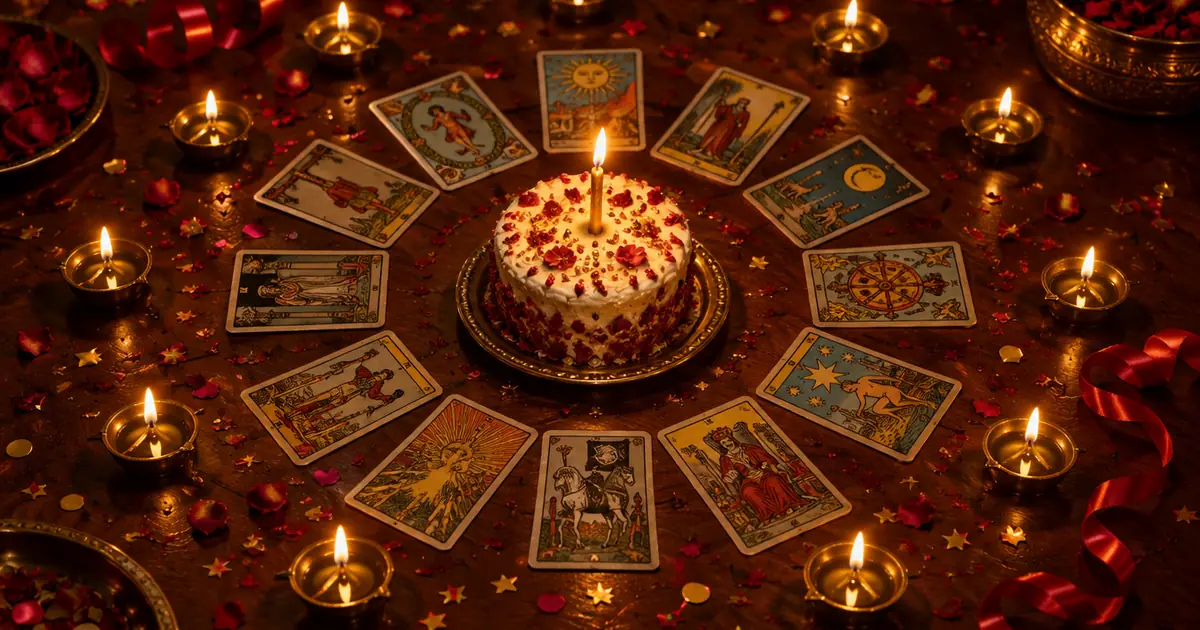
A Twelve-Card Birthday Spread, One Card per Month
A birthday tarot spread with one card for each month of your personal year, laid on or near your birthday and read as themes to watch, never fixed events.
Read article →Quick answers
How many cards are used in a tarot reading?
How many cards are used in a tarot reading? Usually one to ten from a 78-card deck, depending on the spread. A Fort Worth reader explains the common layouts.
Read answer →Is a tarot spread useful when comparing two job offers?
A tarot spread can help when comparing two job offers by clarifying what you value. It never replaces checking pay, benefits and terms. A Fort Worth guide.
Read answer →Talk to Astrologer and Psychic Vijayram
Tell us what you are facing. If a reading is unlikely to help, you will be told that plainly.