

Children, Teens and Psychic Readings
A psychic reading for teenagers is not offered here: readings are for adults aged 18 and over. Teens are still forming their sense of self, and a confident remark about love, ability or the future can stick for years. Parents can instead ask about a child's chart for naming, temperament and ceremony dates, without predictions.
Key takeaways
- The short answer on reading children's palms explains how that is handled at family events.
- A child birth chart reading is different from a reading for the child.
- In many Indian families, grandparents in India or here in Texas want a newborn's kundli made, just as theirs was.
- Curiosity about astrology, tarot and the paranormal is common and usually harmless.
- Family video calls sometimes include everyone, and that is fine for shared topics: a festival date, a griha pravesh, a naming discussion for a new sibling.
Parents sometimes ask about a psychic reading for teenagers: a fifteen-year-old who wants her cards read before a school dance, a seventeen-year-old anxious about college applications, a younger child who seems "sensitive". The answer here is kind but firm. Readings are for adults, 18 and over. This post explains why, and what parents can ask about instead. First, safety. If a young person is in crisis or thinking about self-harm, they or you can call or text the Suicide & Crisis Lifeline at any hour; in danger, call emergency services. If an adult online is offering a minor "readings" and asking for photos, secrecy or money, save the messages, tell a trusted adult and report it to the NCMEC CyberTipline or to the police.
Why readings are for adults
- Teens are still becoming themselves. A remark like "you are not meant for science" or "love will be difficult for you" can shape choices for years, long after the reader has forgotten it.
- Suggestion is powerful at that age. Young people often take an adult's confident words as fact, especially an adult presented as having special insight.
- Consent and payment belong to adults. A minor cannot fairly agree to a paid service about their own private life.
- The questions are usually about growing up. Friendships, grades, crushes and family arguments are best talked through with parents, teachers, school counselors and friends.
The same caution applies to palms. The short answer on reading children's palms explains how that is handled at family events.
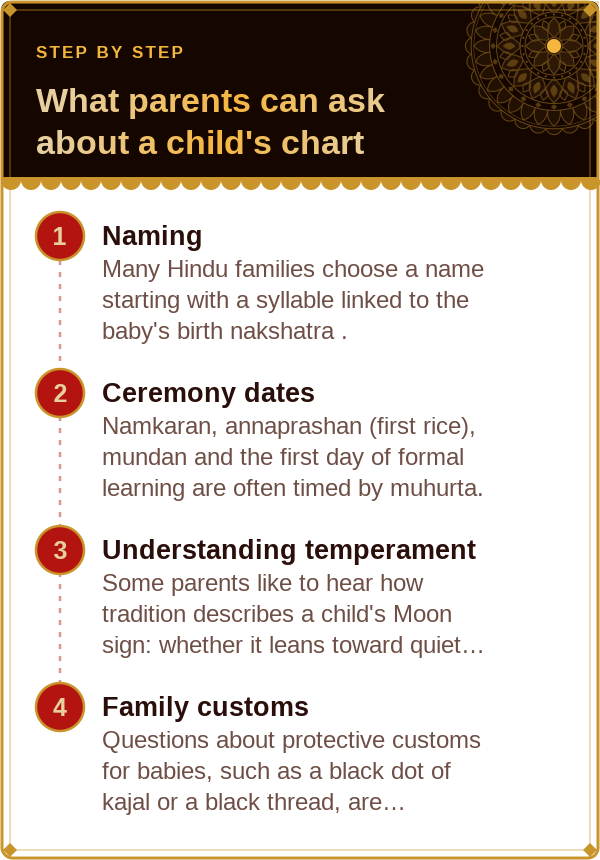
What parents can ask about a child's chart
A child birth chart reading is different from a reading for the child. It is a conversation with the parent, about traditional customs and temperament, with no predictions. Common, sensible questions:
- Naming. Many Hindu families choose a name starting with a syllable linked to the baby's birth nakshatra. A newborn kundli and naming session provides that syllable and a shortlist approach.
- Ceremony dates. Namkaran, annaprashan (first rice), mundan and the first day of formal learning are often timed by muhurta. The post on planning a namkaran ceremony in Tarrant County covers the first.
- Understanding temperament. Some parents like to hear how tradition describes a child's Moon sign: whether it leans toward quiet observation or lively company. Used gently, this can spark patience, never labels.
- Family customs. Questions about protective customs for babies, such as a black dot of kajal or a black thread, are explained with their history in protecting children from nazar.
What is not read, even for parents
- Predictions about a child's marriage, career, income or lifespan.
- Health forecasts. A child's health is for the pediatrician.
- Labels such as "manglik", "difficult chart" or "unlucky" applied to a child.
- Comparisons between siblings' charts.
- Anything a teenager has not agreed to have discussed, such as their relationships.
Children deserve to grow into their own lives without a forecast hanging over them.
When grandparents ask for a grandchild's kundli
In many Indian families, grandparents in India or here in Texas want a newborn's kundli made, just as theirs was. That is a loving custom, and parents can say yes to it on their own terms. Ask for the chart to be used for naming and ceremony dates, and ask that nobody shares forecasts about the child's marriage, health or career with relatives. If a grandparent has already had a chart made elsewhere and been told something frightening, such as a dosha that "must be fixed", a calm second look can explain what the tradition actually says, usually far less alarming than it sounded.
When a teenager is curious
Curiosity about astrology, tarot and the paranormal is common and usually harmless. Some ways to meet it well:
- Look up their Moon sign together and read what different traditions say, as a cultural conversation.
- Explore the history of tarot as art, from Italian card games to modern decks.
- Talk about how to tell guidance from guesswork, and why no honest reader claims certainty.
- If the curiosity seems driven by worry, about exams, friends or the future, gently ask about the worry itself. A school counselor or doctor can help if it is heavy.
Family sessions where a teen is present
Family video calls sometimes include everyone, and that is fine for shared topics: a festival date, a griha pravesh, a naming discussion for a new sibling. If talk turns to the teenager's own future, Astrologer and Psychic Vijayram will steer back to the family matter. It is a quiet boundary, not a rejection.
Online safety for young people
Some accounts on social media target teens with friendly offers of a quick reading that turn into demands for money, photos or secrecy. Teach young people three rules: genuine readers never contact minors, never ask a young person for photos, and never ask anyone to keep secrets from parents. Anyone who breaks those rules should be blocked and reported.
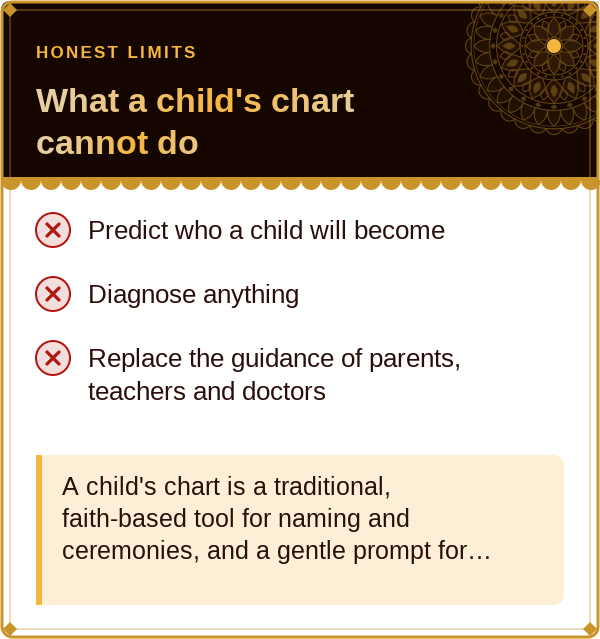
What a child's chart cannot do
A child's chart is a traditional, faith-based tool for naming and ceremonies, and a gentle prompt for reflection. It cannot predict who a child will become, diagnose anything or replace the guidance of parents, teachers and doctors. For adults' own questions, the main psychic reading is the right place to start.
Common questions
At what age can someone book a psychic reading here?
Eighteen. Younger people cannot book a reading of their own, even with a parent's payment. Parents can ask about a young child's chart for naming, ceremonies and understanding temperament.
Can my sixteen-year-old sit in on a family video reading?
A teenager can be present for general family matters, such as a naming discussion for a new sibling or a festival date, but the session will not turn to readings about their own future, love life or abilities.
Can you tell me which career my child should choose?
No. A chart can describe a child's temperament in traditional terms, which some parents find helpful, but career choices belong to the young person, their interests, their teachers and later, themselves as an adult.
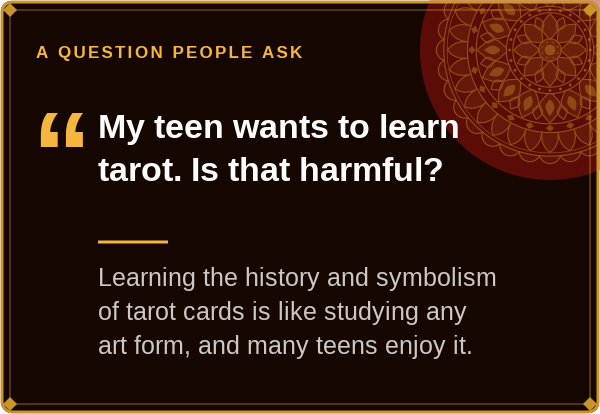
My teen wants to learn tarot. Is that harmful?
Learning the history and symbolism of tarot cards is like studying any art form, and many teens enjoy it. The useful line is between learning about the cards and making serious decisions, or worrying, because of a spread.
Related service

Keep reading

Group Readings for Family Gatherings
How a family psychic reading works at a gathering: setting up a shared video session, agreeing topics in advance, and which subjects are better kept private.
Read article →
Common Myths About Indian Astrologers and Psychics
Common myths about astrologers and psychics: curses, costly remedies and fixed fate. Sorting real Vedic tradition from sales talk, plus fake astrologer signs.
Read article →
Name Numerology When Taking a Spouse's Surname After a Texas Wedding
Name change numerology for newlyweds: how a new full name is calculated, why spelling changes are optional, and the official Texas steps to follow first.
Read article →Quick answers
Is the price agreed before a reading begins?
Yes. For a psychic reading in Fort Worth, the fee and session length are agreed in writing before the reading begins, with nothing added during the call.
Read answer →Can I bring a friend to my first psychic reading?
Yes, a friend can join your first psychic reading in Fort Worth, sitting beside you at home or on the video call, with your consent and a few privacy points.
Read answer →Talk to Astrologer and Psychic Vijayram
Tell us what you are facing. If a reading is unlikely to help, you will be told that plainly.