

Group Readings for Family Gatherings
A family psychic reading is a shared session, usually by video on a living-room screen, where several adults take part with agreed topics and ground rules. It suits remembrance of a shared loss, festival dates or a naming discussion. Health, money, marriage problems and anything about someone who is absent are better kept for private sessions.
Key takeaways
- Astrologer and Psychic Vijayram begins by restating the agreed topics and the ground rules: anyone may pass, anyone may step out, and nobody's private matters will be raised in front of the group.
- A family session is not the place to discuss a sibling who stayed away, an ex-spouse or an absent parent.
- One sister wants to talk about Dad all evening; her brother can barely mention him.
- Video makes it easy to include grandparents in India or Nepal, or siblings in other states.
- In those cases, private sessions, a family relationship reading for one person, or a family counselor are better choices.
A family psychic reading tends to come up when everyone is finally in one place: cousins in from Houston for Thanksgiving, grandparents visiting from Gujarat for a few months, siblings gathered for a death anniversary. Someone says, "Wouldn't it be nice to do a reading together?" It can be, with a little planning. This post covers how a shared session works, which topics suit a group, and which are much better kept private.
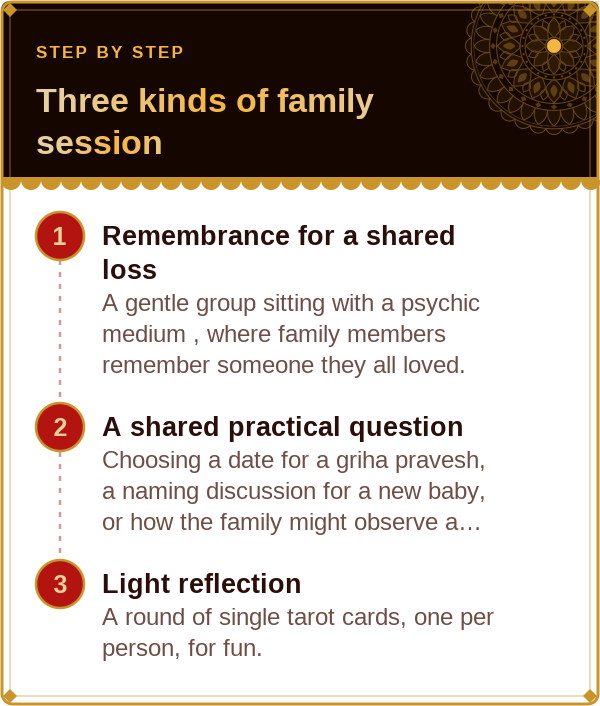
Three kinds of family session
- Remembrance for a shared loss. A gentle group sitting with a psychic medium, where family members remember someone they all loved. This is the most common kind, and the one that needs the most care.
- A shared practical question. Choosing a date for a griha pravesh, a naming discussion for a new baby, or how the family might observe a festival this year in Central Time.
- Light reflection. A round of single tarot cards, one per person, for fun. That is closer to a party format, described in tarot at a Fort Worth party or event.
How a group psychic reading works, step by step
Before the day
- One organizer. One person books, shares the details and collects everyone's agreement.
- Agreed topics. Write down what the session is for. "Remembering Nani" or "Choosing a housewarming date" is clear; "whatever comes up" is not.
- Each adult opts in. Ask everyone individually, not in front of the group, so nobody feels obliged.
- Practical details in writing: length, fee, Central Time start and the time for anyone joining from elsewhere.
Setting up the room
- Cast the video call to a TV, or use a laptop at the end of the table so everyone can see.
- Use one good speaker or a conference microphone; phones passed around make it hard to hear.
- Seat elders close to the screen. Keep tissues and water nearby.
- Agree that phones stay off, and that young children are looked after elsewhere for the hour.
During the session
Astrologer and Psychic Vijayram begins by restating the agreed topics and the ground rules: anyone may pass, anyone may step out, and nobody's private matters will be raised in front of the group. People take turns rather than talking over each other. If something private surfaces, the reader notes it and offers to talk separately later.
Afterward
Leave time to eat together or simply sit. Different people will have felt different things, and that is normal.
Topics for the group, and topics for private sessions
| Good for a group | Better kept private |
|---|---|
| Shared memories of someone who has died | Details of how someone died, or guilt about it |
| Festival, ceremony and housewarming dates | Health, pregnancy and fertility |
| A naming discussion everyone is part of | Money, debts and inheritance |
| Family traditions and how to keep them | Marriage problems or separation |
| A light card each, for reflection | Anything about a relative who is not present |
That last row matters. A family session is not the place to discuss a sibling who stayed away, an ex-spouse or an absent parent. The post on reading for someone else explains why the other person's consent counts.
Remembrance sittings for a shared loss
Families grieve unevenly. One sister wants to talk about Dad all evening; her brother can barely mention him. A teenager is curious, a grandmother is devout, an uncle is openly skeptical. All of that is normal, and the Hospice Foundation of America's guide to grief is a useful reminder that grief has no single shape or schedule. A group sitting should make room for every response, including silence.
Mediumship itself is a faith-based practice with a long history and plenty of scientific skepticism, as the overview of mediumship sets out. In a family setting it is offered as shared remembrance, not proof. For a smaller version with one or two relatives, see bringing family to a medium sitting.
Relatives joining from far away
Video makes it easy to include grandparents in India or Nepal, or siblings in other states. Plan the time carefully, check everyone's connection beforehand and give the remote relatives a turn early, before attention drifts. The post on three generations on one call covers time zones and audio in detail.
When a group session is a bad idea
- The family is in open conflict, especially over money or a will.
- A death was very recent, sudden or traumatic.
- Someone is being pressured to attend or to share.
- The real purpose is to settle an argument about what the person who died "would have wanted".
In those cases, private sessions, a family relationship reading for one person, or a family counselor are better choices.
What a family session cannot do
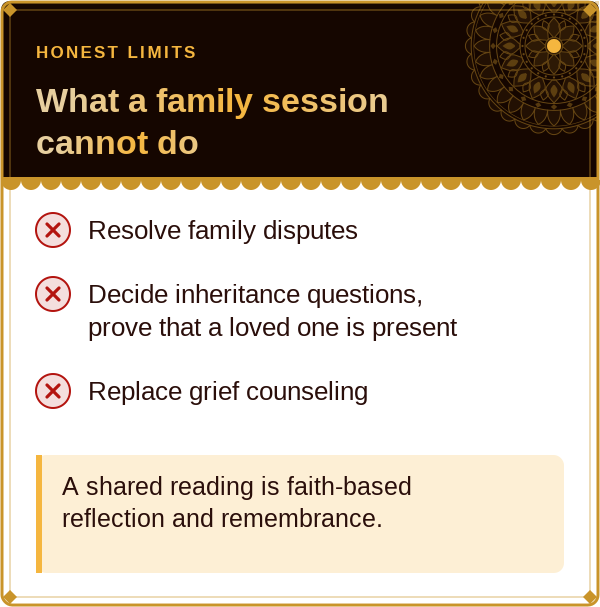
A shared reading is faith-based reflection and remembrance. It cannot resolve family disputes, decide inheritance questions, prove that a loved one is present or replace grief counseling. If grief is overwhelming anyone in the family, the Suicide and Crisis Lifeline (contact the Suicide and Crisis Lifeline) and their doctor come first.
Common questions
How many people can join a family session?
A handful of adults usually works best, so everyone can be heard and nobody feels like an audience member. Larger gatherings can split into a short shared part and separate private conversations afterward.
Can relatives in India or elsewhere join the same call?
Yes. Video calls can include people in several places at once. Times are confirmed for each location, in Central Time for Fort Worth and local time for everyone else, so nobody joins at the wrong hour.
What if someone in the family does not believe in readings?
That is completely fine. They are welcome to listen, to sit out or to skip the session. Nobody should be pressured to take part, and their view deserves the same respect as anyone else's.
Is it wise to hold a group sitting soon after a death?
Usually it is better to wait until the funeral, rites and first weeks have passed. Early grief is raw and uneven across a family, and a counselor, priest or hospice bereavement team is the better first support.
Related service

Keep reading

Common Myths About Indian Astrologers and Psychics
Common myths about astrologers and psychics: curses, costly remedies and fixed fate. Sorting real Vedic tradition from sales talk, plus fake astrologer signs.
Read article →
Name Numerology When Taking a Spouse's Surname After a Texas Wedding
Name change numerology for newlyweds: how a new full name is calculated, why spelling changes are optional, and the official Texas steps to follow first.
Read article →
Personalized Texas License Plates and Numerology: A Light-Hearted Look
Want a lucky number license plate? How numerology adds up the letters and digits on a personalized Texas plate, and why it should stay fun, not a worry.
Read article →Quick answers
Can I stop a medium sitting if it becomes too much?
Yes, you can stop a medium sitting at any point. How a Fort Worth sitting is paused or ended gently, and where to turn for grief support if it feels heavy.
Read answer →Should I bring a photo or keepsake to a medium sitting?
A photo or keepsake is optional at a medium sitting in Fort Worth. What it can help with, what it is never used for, and how to hold one on a video call.
Read answer →Talk to Astrologer and Psychic Vijayram
Tell us what you are facing. If a reading is unlikely to help, you will be told that plainly.