
When Families Match by Name Syllable Alone: Common Mistakes
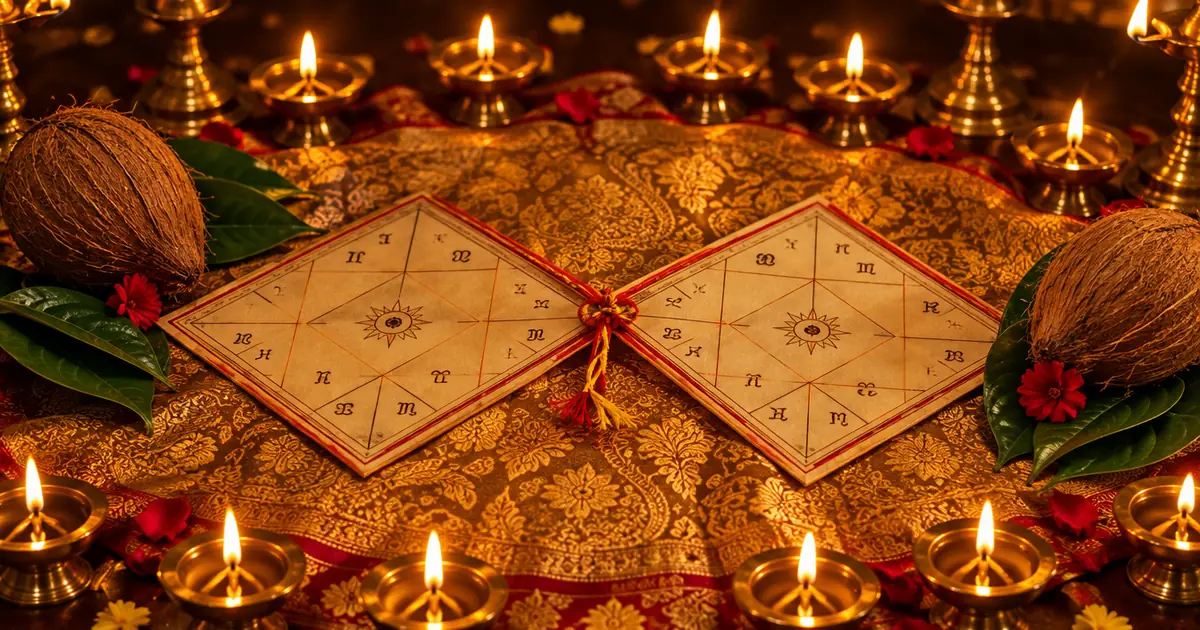
Kundli matching by name gives each person a birth star from the first syllable of their name, then runs a guna milan as if that were the Moon's star. It is a fallback for when no birth details exist. Errors from spelling, nicknames and transliteration from Indian scripts are common, so treat the result with low confidence.
Key takeaways
- The four padas of Ashwini, for example, are linked with the syllables chu, che, cho and la.
- The syllable chart is built on sounds in Sanskrit, not letters in English.
- Devanagari and other Indian scripts distinguish sounds that English spelling merges: dental and retroflex t and d, plain and aspirated consonants, two kinds of "sh," short and long vowels.
- Many astrologers prefer to leave the score out in that case.
- Kundli matching online by name is convenient, and many families in Fort Worth try it first on a phone.
Sometimes there are no birth details at all. A grandmother's papers were lost in a move. A family never kept horoscopes. A refugee family's documents carry only an estimated year. An adopted son knows his birthday but nothing more about the day. For families like these, kundli matching by name is the traditional fallback, and it is used more often around Tarrant County than people admit. It can be done carefully or carelessly, and the difference lies almost entirely in avoiding a handful of predictable mistakes.
How name matching works
Each of the 27 nakshatras is divided into four quarters, called padas, making 108 in all. Tradition assigns each pada a sound. The four padas of Ashwini, for example, are linked with the syllables chu, che, cho and la. To match by name, the astrologer takes the first syllable of each person's name, finds the pada it belongs to, and treats that as the birth star. The Moon sign follows from the star, and a normal guna milan is run on the result.
The same syllable chart works in reverse at a baby's naming ceremony, when parents choose a name beginning with the sound of the child's birth star, as described in planning a namkaran ceremony in Tarrant County. That connection matters, as you will see below.
Mistake one: matching the English spelling instead of the sound
The syllable chart is built on sounds in Sanskrit, not letters in English. "Shreya," "Sreya" and "Shriya" may all be the same name, or may not, depending on how the family actually says it. A name beginning with "Ch" might be the plain or the aspirated sound, which belong to different padas. Working from the written English alone is the single most common source of error.
Mistake two: losing distinctions in transliteration
Devanagari and other Indian scripts distinguish sounds that English spelling merges: dental and retroflex t and d, plain and aspirated consonants, two kinds of "sh," short and long vowels. The overview of Devanagari transliteration shows how many competing systems exist for writing these sounds in Roman letters, and an ordinary passport spelling follows none of them consistently. Tamil script, which does not mark aspiration the same way, adds another layer. Two astrologers working from the same English spelling can reasonably pick different syllables.
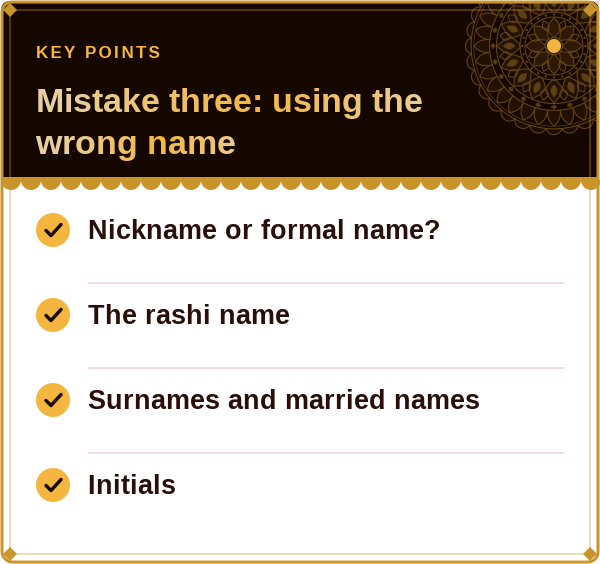
Mistake three: using the wrong name
- Nickname or formal name? Many astrologers use the name a person answers to every day, on the reasoning that it is the name that carries their identity. Others use the formal name. Agree on one before you begin.
- The rashi name. If the person was given a name from their birth star at a naming ceremony, that name may encode the real birth star. It is worth asking grandparents whether such a name exists.
- Surnames and married names. Use the given name, not the family name. In some communities a bride receives a new first name at marriage; for matching before the wedding, use the name she has now.
- Initials. Names written as initials in South Indian style need to be expanded first.
Mistake four: forcing a fit for non-Indian names
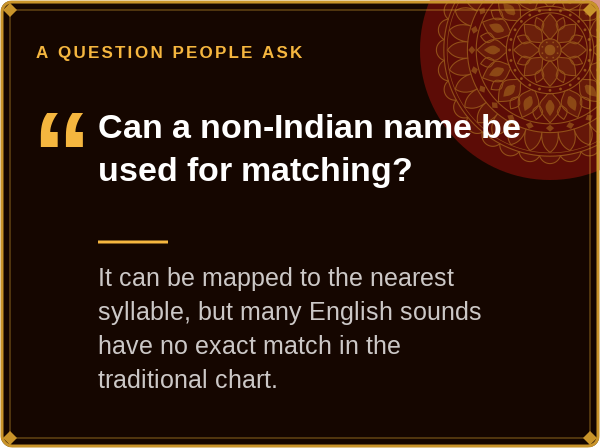
When one partner grew up in Texas with a name like Kevin, Ashley or Wyatt, the syllable chart struggles. Some English sounds, such as w, z or f, have no exact place in it, and mapping them to the nearest sound is guesswork. Many astrologers prefer to leave the score out in that case. If the partner knows their birth date, a date-based match is far better; see matching from the records you have. If the partner's family is new to the tradition altogether, explaining kundli matching to your Texan in-laws may help.
Mistake five: trusting the tool without checking it
Kundli matching online by name is convenient, and many families in Fort Worth try it first on a phone. Most tools convert English letters to a syllable automatically and never show you which one they chose. If you use one, find out what syllable and pada it assumed for each person. You may find it picked "ka" when the name begins with "kha," and the whole score rests on that guess.
How to reduce the errors
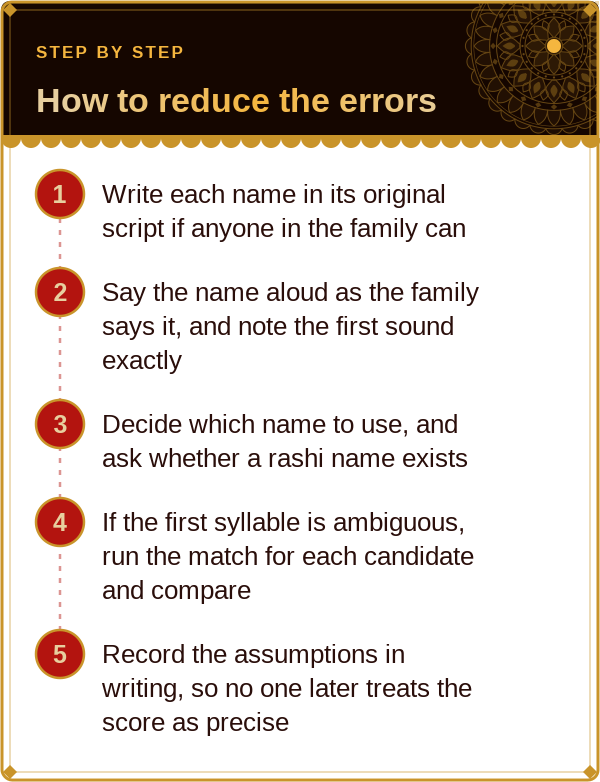
- Write each name in its original script if anyone in the family can.
- Say the name aloud as the family says it, and note the first sound exactly.
- Decide which name to use, and ask whether a rashi name exists.
- If the first syllable is ambiguous, run the match for each candidate and compare.
- Record the assumptions in writing, so no one later treats the score as precise.
When not to use name matching
Name matching is a last resort, not a shortcut. If either person has a birth date, use it. If the score is going to be used to reject a match, stop and ask whether such an uncertain number should carry that weight. Usually it should not. In a kundli matching session, Astrologer and Psychic Vijayram uses the best records available, explains every assumption, and says clearly when a name-only score is too uncertain to rely on. The tradition itself treats name matching as a fallback, and the families who use it wisely treat it the same way.
Common questions
Is kundli matching online by name accurate?
It is the least precise kind of matching. Online tools guess the syllable from English spelling, which often misreads Indian names. Treat the score as a rough indicator at best, and check which syllable the tool assumed.
Which name should be used, the official one or the one people call me?
Traditions differ. Many astrologers use the name a person answers to every day. If you were given a rashi name from your birth star at your naming ceremony, that one is often the most useful of all.
Can a non-Indian name be used for matching?
It can be mapped to the nearest syllable, but many English sounds have no exact match in the traditional chart. Many astrologers would rather skip the score than rely on a forced fit.
Related service
Keep reading

Questions to Discuss Before Marriage That No Chart Answers
Questions before marriage that no chart answers: money, children, faith, family and where to live. A practical list for Fort Worth couples to talk through.
Read article →
Church and Temple in One Weekend: A Fort Worth Interfaith Wedding
Interfaith marriage astrology for Fort Worth couples holding a church service and a Hindu ceremony: what can follow a muhurta, and when to leave it out.
Read article →
In-Law Harmony: What the Chart Can and Cannot Do
In-law problems and astrology: how the fourth and tenth houses offer perspective, and why boundaries and plain talk do the real work in Tarrant County homes.
Read article →Quick answers
Do gunas matter if we are already engaged?
If you are already engaged, guna scores still offer useful talking points, used as guidance rather than a veto. How kundli matching helps Fort Worth couples.
Read answer →Can we marry if our kundlis do not match?
Yes, you can marry if your kundlis do not match. How kundli matching is done, whether it is necessary for a love marriage, and what Fort Worth couples weigh.
Read answer →Talk to Astrologer and Psychic Vijayram
Tell us what you are facing. If a reading is unlikely to help, you will be told that plainly.