
No Birth Time on the Certificate? Matching From the Records You Have
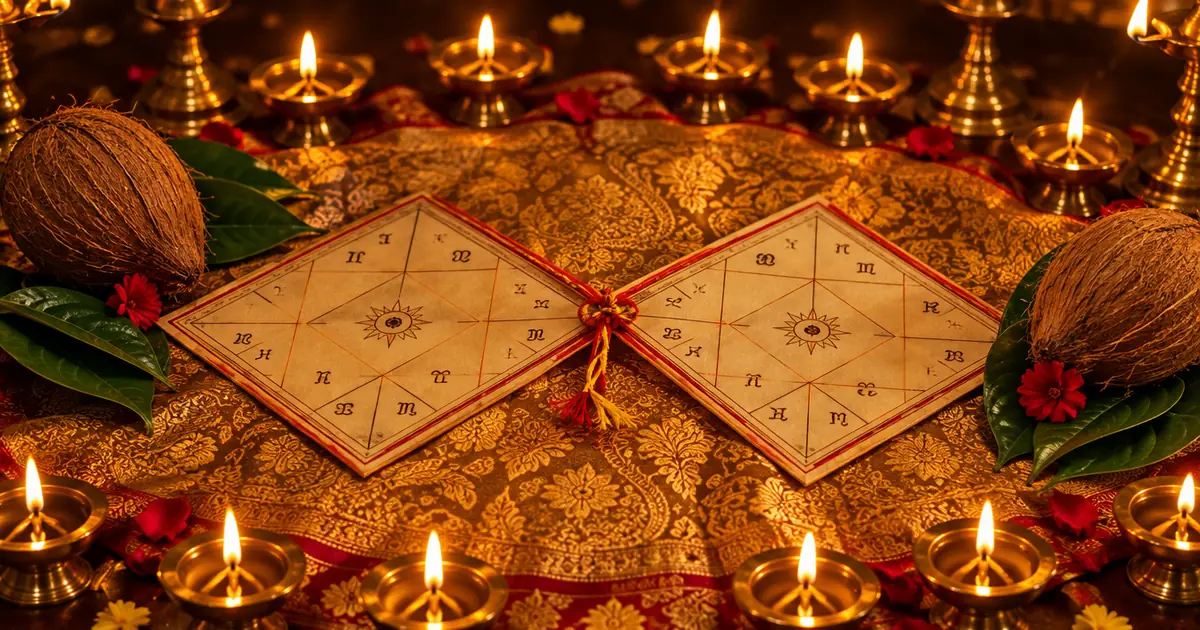
Kundli matching without birth time is possible because guna milan depends mainly on the Moon, which a date and place usually fix to one sign and one or two birth stars. Confidence drops when the Moon changed star that day, and the ascendant, houses and navamsa cannot be read, so expect a partial match, clearly labeled.
Key takeaways
- Guna milan, the familiar score out of 36, compares the two Moons: each person's Moon sign and birth star, one of the 27 nakshatras .
- Before settling for a partial match, it is worth one more search.
- A partial match can tell a family whether the Moons sit comfortably together, whether nadi or bhakoot raise questions, and whether Mars needs a closer look.
Many Indian birth certificates, especially older ones issued by municipal offices, list the date and place of birth but no time. Others give a time rounded to the hour, or a note that says only "morning." In Fort Worth, families often discover the gap the week a proposal arrives, when someone digs out the certificate and finds the line empty. Kundli matching without birth time is still possible, and often more useful than people expect, as long as everyone understands what it can and cannot cover.
What a date and place still give you
Guna milan, the familiar score out of 36, compares the two Moons: each person's Moon sign and birth star, one of the 27 nakshatras. The Moon moves about 13 degrees a day, and each nakshatra spans 13 degrees 20 minutes. So on any given date, the Moon usually spends part of the day in one star and part in the next, or occasionally the whole day in one. The Moon changes sign only about every two and a quarter days.
In practice, a date and place usually give you the Moon sign with certainty and narrow the birth star to one or two candidates. Since the guna score depends almost entirely on those two facts, much of a traditional match survives the missing time.
What you lose without a time
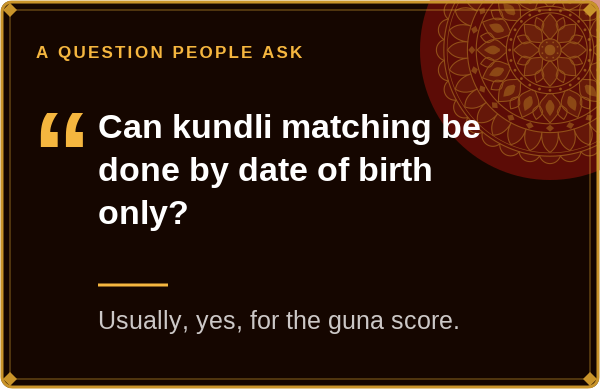
- The ascendant and houses. The rising sign changes about every two hours, so without a time there is no reliable seventh house, no seventh lord placement, and no house-based reading. The general structure of the kundali chart depends on that rising sign.
- Manglik from the ascendant. Mars can still be checked from the Moon and from Venus, which many astrologers use anyway, but not from the ascendant.
- The navamsa rising sign, which changes every few minutes. The post on navamsa lagna and vargottama planets explains why it is so time-sensitive.
- Precise dasha dates. Planetary periods are calculated from the Moon's exact position, and a day's uncertainty can move period dates by years. Timing questions become much rougher.
Records that may fill the gap
Before settling for a partial match, it is worth one more search. Places to look:
- A horoscope written by the family priest after the birth, which often records the time even when the certificate does not
- Hospital discharge papers or a doctor's note
- For anyone born in Texas, the state birth record, described in finding a Texas birth time
- Parents' and grandparents' memories tied to daily events: "just after the evening aarti," "before the milkman came"
The short answer on whether you need a birth certificate for a Vedic reading explains which documents help. A remembered time narrowed to a two-hour window is already a big improvement over none.
How a matching proceeds without a time
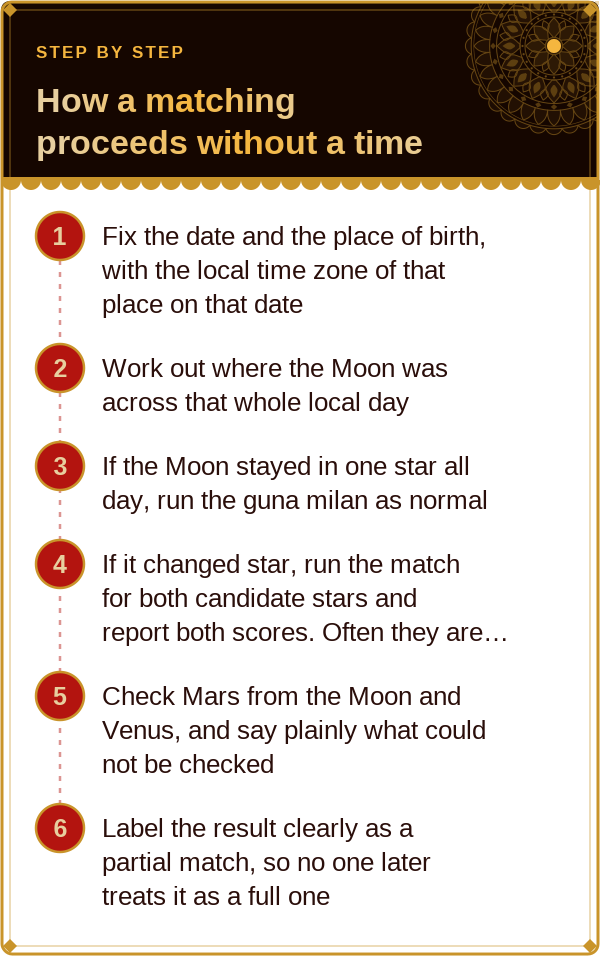
- Fix the date and the place of birth, with the local time zone of that place on that date.
- Work out where the Moon was across that whole local day.
- If the Moon stayed in one star all day, run the guna milan as normal.
- If it changed star, run the match for both candidate stars and report both scores. Often they are close; sometimes they differ sharply, and that difference is part of the honest answer.
- Check Mars from the Moon and Venus, and say plainly what could not be checked.
- Label the result clearly as a partial match, so no one later treats it as a full one.
How much confidence to expect
| What you have | What can be compared | Confidence |
|---|---|---|
| Time to the minute | Everything, including houses and navamsa | Full |
| Time rounded to the hour | Guna milan, most houses; navamsa rising sign uncertain | Good |
| "Morning" or "night" only | Guna milan; houses only as possibilities | Moderate |
| Date and place only | Guna milan, sometimes with two candidate stars; Mars from Moon and Venus | Partial |
| No reliable date | A name-syllable match only | Low |
That last row has its own pitfalls, covered in matching by name syllable alone.
What a partial match is good for
A partial match can tell a family whether the Moons sit comfortably together, whether nadi or bhakoot raise questions, and whether Mars needs a closer look. In a full kundli matching session, Astrologer and Psychic Vijayram adds whatever the records allow and is clear about the rest. What no match can do, with or without a birth time, is decide for a couple whether to marry. A missing time only makes that limit easier to see.
Common questions
Can kundli matching be done by date of birth only?
Usually, yes, for the guna score. The date and place fix the Moon sign and narrow the birth star to one or two possibilities. House-based checks and the navamsa need a birth time.
Is it worth working out a birth time before matching?
Sometimes. Estimating a time from past life events is slow and uncertain, so it suits people who also want a full personal reading. For matching alone, a clearly labeled partial match is often enough.
Does the place of birth matter if there is no time?
Yes. The place sets the time zone, which decides when the Moon changed star by local reckoning, so two births on the same calendar date in different countries can give different results.
Can manglik dosha be checked without a birth time?
Partly. Without a time, Mars can be counted from the Moon and from Venus but not from the ascendant. Many astrologers give the Moon-based check real weight anyway, so the result is useful, but it should be labeled incomplete.
Is a chart drawn from an estimated time better than none?
Only if everyone remembers it is estimated. An estimate can mislead more than an honest gap, because people forget the guess and treat the houses and navamsa as fact. Label it clearly, or match on the Moon alone.
Related service
Keep reading
When Families Match by Name Syllable Alone: Common Mistakes
Kundli matching by name is used when no birth details exist. The common errors with spelling, nicknames and transliteration, and how to reduce them.
Read article →
Questions to Discuss Before Marriage That No Chart Answers
Questions before marriage that no chart answers: money, children, faith, family and where to live. A practical list for Fort Worth couples to talk through.
Read article →
Church and Temple in One Weekend: A Fort Worth Interfaith Wedding
Interfaith marriage astrology for Fort Worth couples holding a church service and a Hindu ceremony: what can follow a muhurta, and when to leave it out.
Read article →Quick answers
Do gunas matter if we are already engaged?
If you are already engaged, guna scores still offer useful talking points, used as guidance rather than a veto. How kundli matching helps Fort Worth couples.
Read answer →Can we marry if our kundlis do not match?
Yes, you can marry if your kundlis do not match. How kundli matching is done, whether it is necessary for a love marriage, and what Fort Worth couples weigh.
Read answer →Talk to Astrologer and Psychic Vijayram
Tell us what you are facing. If a reading is unlikely to help, you will be told that plainly.