
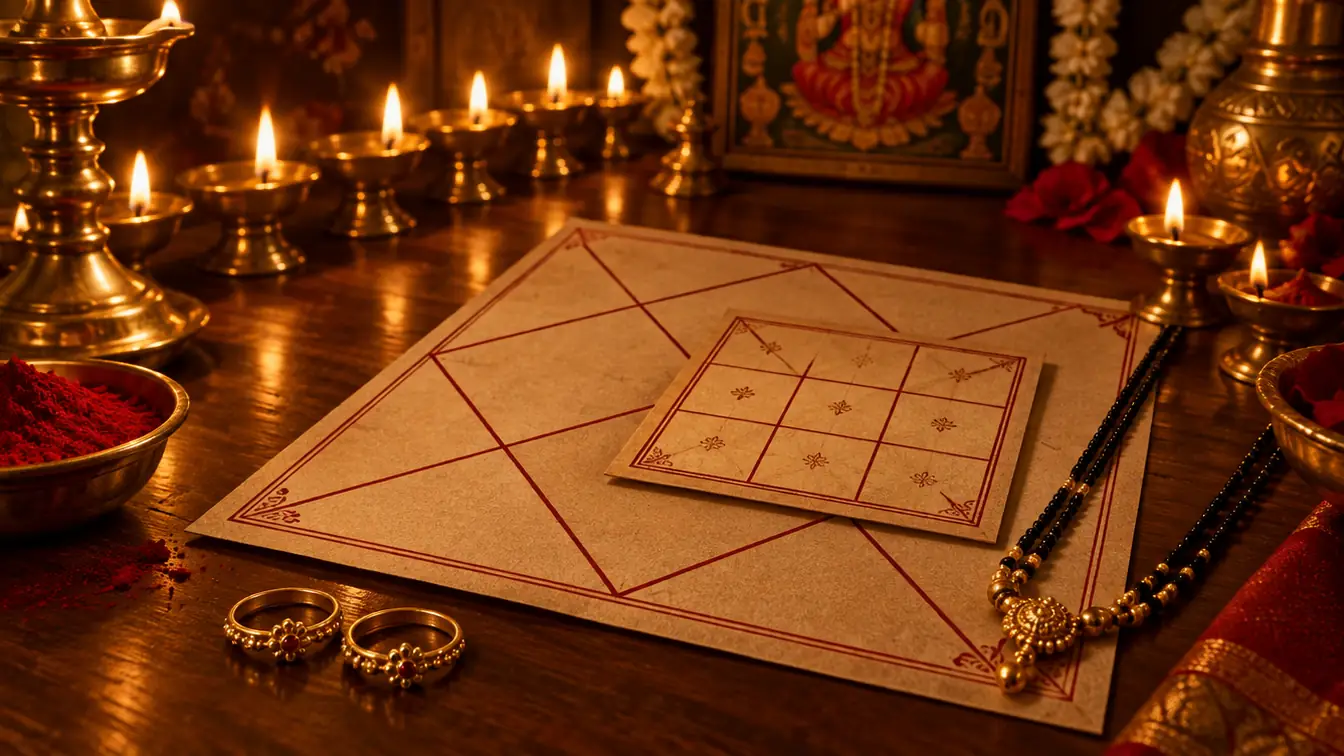
Navamsa Lagna and Vargottama Planets: A Closer Look for Couples
In navamsa chart marriage readings, the D9 is a divisional chart that splits each sign into nine parts and is traditionally read for marriage and inner strength. Two checks stand out: the navamsa lagna, which colors how a person lives inside a marriage, and vargottama planets, which hold the same sign in both charts and are read as steady.
Key takeaways
- The navamsa divides every sign into nine equal parts of 3 degrees 20 minutes, and the chart is redrawn according to which part each planet occupies.
- The rising sign moves through all twelve signs in a day, about two hours each on average, so the navamsa lagna changes roughly every thirteen minutes, faster or slower depending on the sign.
- The main chart's ascendant describes how a person meets the world.
- A planet is vargottama when it occupies the same sign in the main chart and in the navamsa.
- In a yearly chart review for married couples , the navamsa sits beside each partner's main chart and the planetary periods running that year.
Couples who have had a kundli matching often notice a second, smaller chart on the printout, labeled D9 or navamsa, and wonder why it is there. In a navamsa chart marriage reading, that small chart does a great deal of the work. This post looks at two specific checks, the navamsa rising sign and vargottama planets, and what each adds to a reading for couples.
What the navamsa is
Each sign of the zodiac spans 30 degrees. The navamsa divides every sign into nine equal parts of 3 degrees 20 minutes, and the chart is redrawn according to which part each planet occupies. Parashara describes it among the sixteen divisional charts in the chapter on the vargas, and in the chapter on what each varga shows links the navamsa with the spouse. The general system is summarized under varga.
One neat detail: there are 108 navamsas in the zodiac, exactly the number of nakshatra quarters, or padas. Each navamsa matches one pada, which is why the birth star and the navamsa are so closely connected.
Why the birth time matters so much here
The rising sign moves through all twelve signs in a day, about two hours each on average, so the navamsa lagna changes roughly every thirteen minutes, faster or slower depending on the sign. A time rounded to the nearest half hour can easily give the wrong navamsa lagna. The Moon changes navamsa about every six hours, and the slower planets stay put for days or weeks. In practice, that means the planets in the D9 are usually reliable while the D9 rising sign is only as good as the birth record. If your time is uncertain, see finding a Texas birth time or matching from the records you have.
Check one: the navamsa lagna
The main chart's ascendant describes how a person meets the world. The navamsa lagna is traditionally read for how that person lives inside close partnership: their habits at home, their maturity in commitment, what they value once the wedding is over. A popular modern view also links the navamsa with the second half of life.
An illustration: someone with Aries rising in the main chart may come across as direct and fast-moving at work, while a Cancer navamsa lagna suggests a more protective, family-centered person at home. Neither describes the whole person; together they describe a fuller one.
For couples, the astrologer compares the two navamsa lagnas: whether their elements sit comfortably together, whether their ruling planets are friends, and how each partner's seventh house in the D9 is occupied.
Check two: vargottama planets
A planet is vargottama when it occupies the same sign in the main chart and in the navamsa. It happens in a predictable zone of each sign:
| Type of sign | Signs | Vargottama zone |
|---|---|---|
| Movable | Aries, Cancer, Libra, Capricorn | The first 3 degrees 20 minutes |
| Fixed | Taurus, Leo, Scorpio, Aquarius | The middle part, 13 degrees 20 minutes to 16 degrees 40 minutes |
| Dual | Gemini, Virgo, Sagittarius, Pisces | The last 3 degrees 20 minutes |
Vargottama planets are read as strengthened and consistent: the planet behaves the same way in public and in private. In a marriage reading, a vargottama Venus or seventh lord is often read as steadiness in partnership. A vargottama lagna is read as a person whose outer and inner lives match. But strength magnifies a planet's own nature. A vargottama Saturn brings steady seriousness and a strong sense of duty, which can be a gift or a weight depending on the rest of the chart.
For couples, it is interesting to compare which planets are vargottama in each chart. When one partner's vargottama planet rules the other's seventh house, astrologers often take note of the connection.
Where the D9 fits in a couples reading
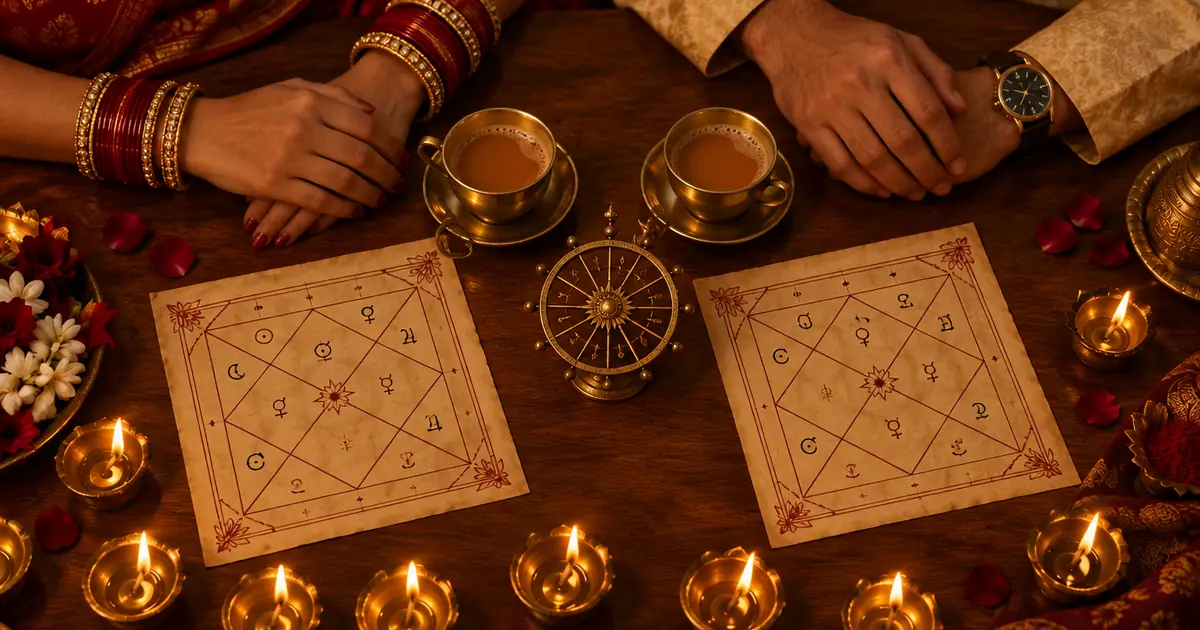
In a yearly chart review for married couples, the navamsa sits beside each partner's main chart and the planetary periods running that year. In a premarital comparison it complements kundli matching, which starts from the Moons. Both readings are offered by phone, WhatsApp or video, with times in Central Time.
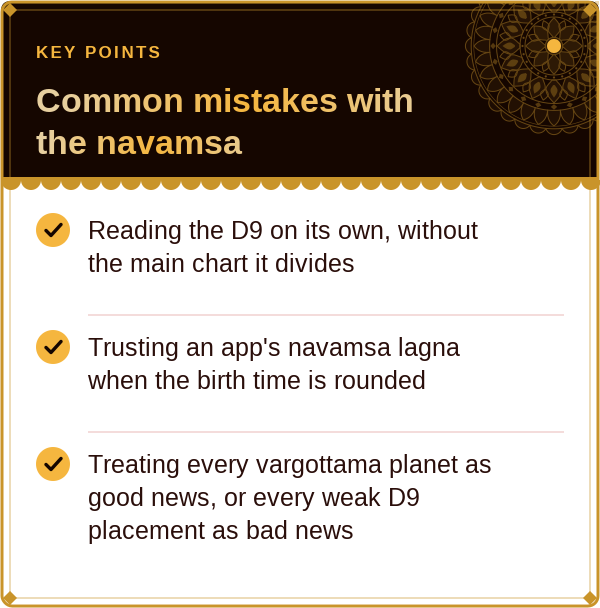
Common mistakes with the navamsa
- Reading the D9 on its own, without the main chart it divides.
- Trusting an app's navamsa lagna when the birth time is rounded.
- Treating every vargottama planet as good news, or every weak D9 placement as bad news.
Astrologer and Psychic Vijayram uses the navamsa as a second lens, never the only one. It cannot tell you whether a marriage will be happy. It adds detail to a picture that the couple, through their own choices, are still painting.
Common questions
What is the D9 chart meaning in simple terms?
The D9, or navamsa, divides each sign into nine parts and redraws the chart from them. Tradition reads it for marriage and the spouse, and for the inner strength of each planet.
Can a navamsa reading be done without an exact birth time?
Only partly. Most planets stay in the same navamsa for hours or days, but the navamsa lagna can change every few minutes, so a rounded or estimated time makes that part unreliable.
Is a vargottama planet always good?
It is read as strong and consistent, which magnifies whatever that planet signifies. A vargottama Venus is read as steady affection; a vargottama Saturn as steady seriousness and duty.
Should couples compare their navamsa charts?
It adds depth to a matching or a yearly review, especially the two D9 rising signs and Venus. It should sit beside the main birth charts, never replace them.
Why do two apps show different navamsa charts for me?
Usually because of a small difference in birth time, time zone or ayanamsa setting. Because the navamsa lagna changes every few minutes, a five-minute disagreement can produce a different D9 rising sign. The short answer on why dashas differ between apps covers the same problem.
Related service
Keep reading
Why Marriage Gets Delayed: An Astrological View
Delayed marriage astrology reasons, from Saturn and the seventh lord to dasha timing, set beside the ordinary reasons people in Fort Worth marry later.
Read article →
Remarrying in Tarrant County: Blended Families and the Chart
Second marriage astrology for divorced or widowed Tarrant County clients: what the chart is checked for, how children shape the talk, and who decides.
Read article →
No Birth Time on the Certificate? Matching From the Records You Have
Kundli matching without birth time: how matching proceeds from date and place, what happens when the birth star is uncertain, and how much confidence to expect.
Read article →Quick answers
Do gunas matter if we are already engaged?
If you are already engaged, guna scores still offer useful talking points, used as guidance rather than a veto. How kundli matching helps Fort Worth couples.
Read answer →Can we marry if our kundlis do not match?
Yes, you can marry if your kundlis do not match. How kundli matching is done, whether it is necessary for a love marriage, and what Fort Worth couples weigh.
Read answer →Talk to Astrologer and Psychic Vijayram
Tell us what you are facing. If a reading is unlikely to help, you will be told that plainly.