
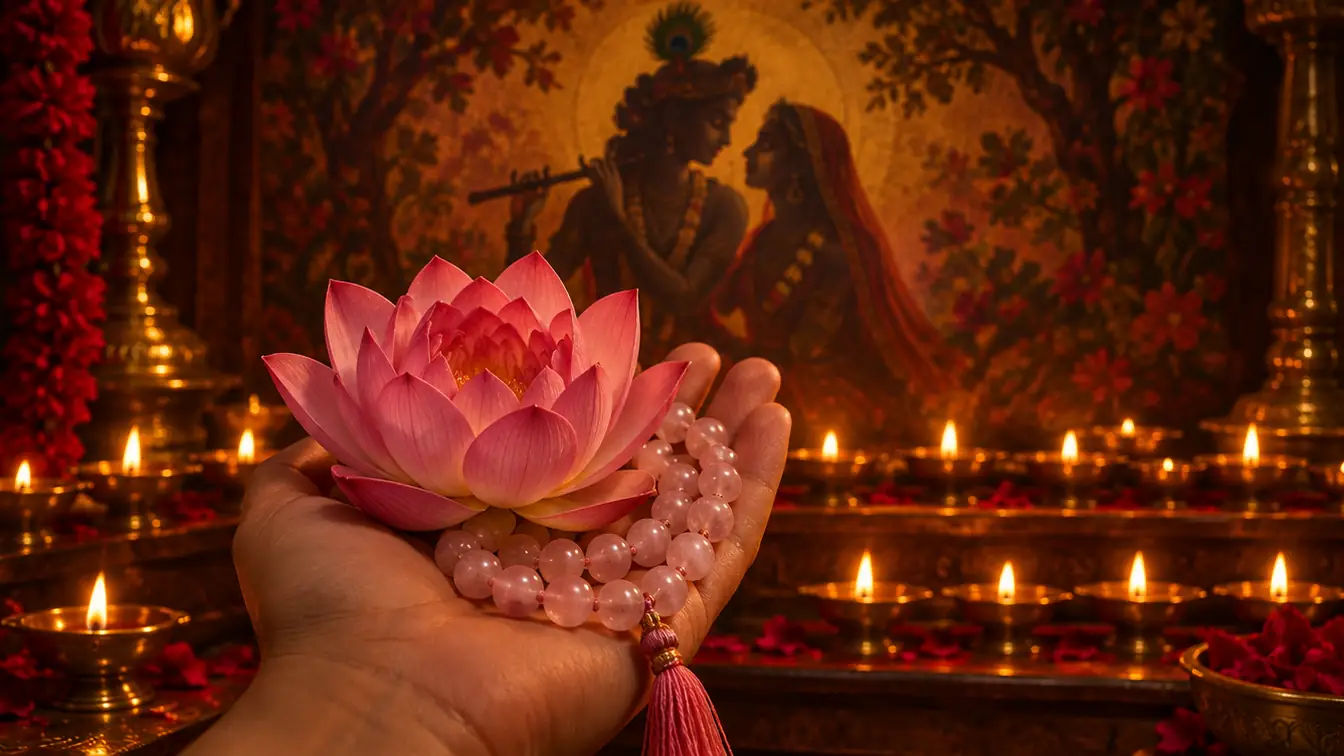
Mantra and Prayer for Your Own Love Life: A Home Routine
A mantra for your love life is a short sacred phrase you repeat for steadiness, readiness and harmony in love. A simple Vedic routine pairs a sankalpa, a stated intention, with a Friday Shukra mantra or a family prayer for a good marriage. It is devotion, and no result is promised.
Key takeaways
- A home mantra and a spell sold with deadlines can look alike from outside: words, a lamp, a set time.
- In a traditional puja, the sankalpa is the opening resolve.
- In Jyotish, Venus is Shukra, the planet traditionally linked with love, beauty, comfort and harmony between partners; the article on Shukra in Hindu tradition covers the mythology behind it.
- Many Hindu families keep prayers made for this exact hope.
- Some people want to hear a mantra chanted before trying it alone.
People who come looking for a love spell are often surprised by what a Vedic practice offers: alongside the love-back prayer and puja done by the reader, a mantra for your love life that you say yourself. A mantra, in the Hindu tradition, is a sacred sound or phrase repeated to steady and focus the mind of the one who says it; the overview of mantra in Indian religions traces how widely the practice spread. This guide gives a simple routine you can keep at home in Fort Worth, and explains where the love spell and ex-back service fits if you want help choosing the words.
Why a mantra is not a pressure-sold spell
A home mantra and a spell sold with deadlines can look alike from outside: words, a lamp, a set time. Underneath they point in opposite directions.
| A spell sold with pressure | A mantra practice |
|---|---|
| Aimed at controlling a named person | Aimed at your own attention and conduct |
| Promises a result, often by a date | Promises nothing; it is devotion |
| Sold with a deadline and a fee that keeps rising | Said by you, at home, for as long as you choose |
| Hidden, often with a warning not to tell family | Open; family members often say the same prayers |
That last row matters more than it seems. A practice you can describe to your mother or your best friend without embarrassment is usually a healthy one.
Step one: a sankalpa that names your own hope
In a traditional puja, the sankalpa is the opening resolve. The worshipper states a name, the place, the date and the purpose. Place and date are meant literally. A priest in India names the region and the lunar date there; in Fort Worth, the honest version names where you live and uses a calendar worked out for this city, because the tithi in Central Time can differ from the one printed in an almanac from India. The Hindu calendar calculated for Fort Worth gives the local tithi and sunrise for each day.
Then the purpose. Keep it about you. A few examples:
- "May I heal from this breakup without bitterness."
- "May I be ready for a partnership built on respect."
- "May I speak honestly with the person I love, and accept the answer."
A hope for reconciliation belongs here too, as long as it is spoken with goodwill and leaves the other person's choice with them: "May the two of us be reconciled, if it is good for us both." A fuller sankalpa naming both of you is part of the love-back puja done with the reader.
Step two: a Friday Shukra mantra
In Jyotish, Venus is Shukra, the planet traditionally linked with love, beauty, comfort and harmony between partners; the article on Shukra in Hindu tradition covers the mythology behind it. Friday is Shukravara, the day of Venus, so a Friday practice is the classic choice for prayers about love and marriage. The simplest form is the name mantra Om Shukraya Namah, "salutations to Shukra." Counts of 11, 27 or 108 are common, and a mala of 108 beads helps if you like to count by touch rather than in your head.
Dawn is the traditional time. In Fort Worth that clock time moves a great deal across the year, and when daylight saving time ends in early November the sunrise suddenly comes an hour earlier on the clock, so check the local sunrise rather than keeping a fixed hour. In July and August the early morning is also the only cool part of a North Texas day, which makes a balcony or back-porch practice possible before the heat sets in.
If you would like to honor all nine planets across the week, the post on navagraha mantras matched to the weekdays has the full rotation.
Step three: family prayers for a good marriage
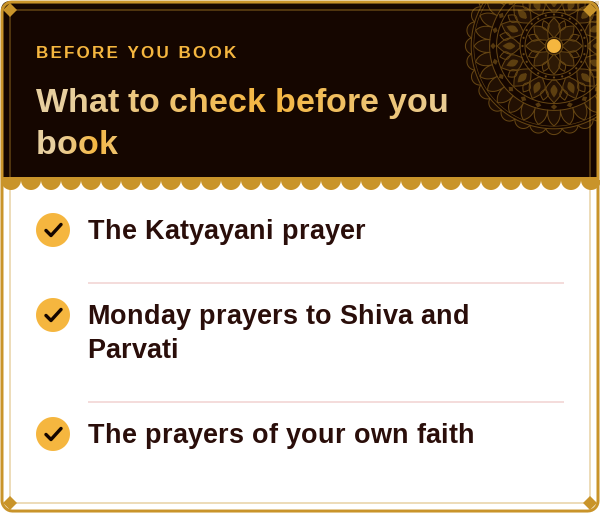
Many Hindu families keep prayers made for this exact hope. Three are widely known:
- The Katyayani prayer. In the Bhagavata Purana, the young women of Vraja keep a month-long vow to the goddess Katyayani, asking for Krishna as their husband. Families today often recite the Katyayani mantra for a good marriage in general. The old verse names Krishna; in a present-day practice the honest approach is to keep the wish general and never put a real person's name in that place.
- Monday prayers to Shiva and Parvati. Parvati's long devotion before her marriage to Shiva is the classic picture of patient love, and some unmarried women keep Monday fasts in that spirit. If you fast, keep it gentle in summer heat, and talk to your doctor first if you are pregnant, diabetic or take medication with food.
- The prayers of your own faith. A novena, a psalm or a dua serves the same purpose. The structure of intention, repetition and a regular time is what carries the practice.
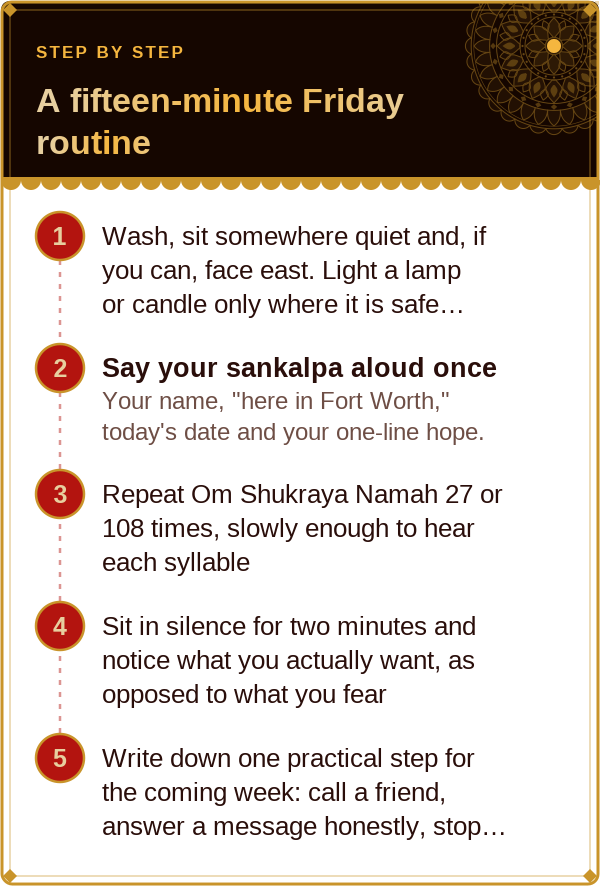
A fifteen-minute Friday routine
- Wash, sit somewhere quiet and, if you can, face east. Light a lamp or candle only where it is safe, and never leave a flame burning when you step away.
- Say your sankalpa aloud once: your name, "here in Fort Worth," today's date and your one-line hope.
- Repeat Om Shukraya Namah 27 or 108 times, slowly enough to hear each syllable.
- Sit in silence for two minutes and notice what you actually want, as opposed to what you fear.
- Write down one practical step for the coming week: call a friend, answer a message honestly, stop checking a profile.
If you are short on space, the post on setting up a prayer corner in a small Fort Worth apartment has lease-friendly ideas.
Where community fits
Some people want to hear a mantra chanted before trying it alone. Programs at the Hindu Temple of Greater Fort Worth on the far west side, or at the DFW Hindu Temple Society's Ekta Mandir in Irving, are good places to listen; check each temple's own website for current times rather than an old listing. Temple circles are also where some people meet a future partner, a subject the post on meeting someone through temple or gurdwara circles handles gently.
When to ask for help choosing words
A personal mantra can be matched to your chart, for example when Venus is weak, or when you are in a Venus dasha and feelings run high. A session with Astrologer and Psychic Vijayram through the love spell and ex-back sessions looks at your situation, performs the prayer and puja for reconciliation where you ask for it, and leaves you with a practice you keep yourself. If your worry runs the other way, that someone has worked a spell against you, start with what to do if you fear a love spell.
What a mantra cannot do
A home mantra is devotion, and no result is promised: the other person's choice remains theirs, and nothing here is aimed at making anyone leave someone else. It can steady you, clarify what you want and leave you readier to meet it. If low mood, sleeplessness or looping thoughts about one person are taking over your days, see a doctor or counselor; prayer can sit beside that care, never in place of it.
Common questions
Can a mantra make a specific person love me?
A mantra said at home is a devotional practice for the person who says it, and no result is promised. Where you want a partner or an ex back, Astrologer and Psychic Vijayram offers separate love-back work: a reading, then prayer, mantra and puja for reconciliation, never an attempt at control.
Which mantra is used for love and marriage?
Om Shukraya Namah, said on Fridays for Venus, is the simplest. Many families also recite the Katyayani prayer for a good marriage. A prayer from your own faith can fill the same place in the routine.
Do I have to be Hindu to do this?
No. The shape of the practice, a clear intention, a short repeated prayer and a regular time, suits any faith. Some people use a psalm, a decade of the rosary or a line from their own scripture instead of a Sanskrit mantra.
How long before I see a change?
There is no timeline, and anyone who gives one is guessing. What people tend to notice first is inside: steadier sleep, fewer late-night messages, more patience. Any change in your love life still depends on choices, yours and other people's.
Related service

Keep reading

Think a Love Spell or Binding Was Put on You? What to Check and What Is Offered
Signs someone put a love spell on you: the everyday causes to check, how spell removal by prayer and puja is offered, and help in Tarrant County.
Read article →
Dating Across the Metroplex: Fort Worth, Dallas and the Miles Between
Dating in Fort Worth with a partner in Dallas: how the I-30 commute shapes a couple, what your charts say about distance, and practical ideas that help.
Read article →
The Year After a Tarrant County Divorce: Saturn and New Routines
Dating after divorce in Fort Worth: the first year after a Tarrant County decree read through Saturn's slow periods, with routines for rebuilding.
Read article →Quick answers
Will you read my ex's birth chart without their consent?
No. Your ex's birth chart is not read without their consent. Why a Fort Worth breakup reading focuses on your own chart, and what it can show you instead.
Read answer →Can a love reading help after I have been ghosted?
A love reading can help after you have been ghosted by sorting out your own feelings and next steps. It cannot explain the other person's silence for them.
Read answer →Talk to Astrologer and Psychic Vijayram
Tell us what you are facing. If a reading is unlikely to help, you will be told that plainly.