

Meeting Someone Through Temple or Gurdwara Circles in Tarrant County
Meeting a partner through temple community or gurdwara events works best when it stays low-pressure: volunteer, attend regularly, let conversations grow naturally, and involve family once both people are interested. A reading can help with timing and compatibility later, but consent, shared values and honest conversation matter more than any chart.
Key takeaways
- West of downtown, the Hindu Temple of Greater Fort Worth sits on Longvue Avenue on the far west side.
- The flip side is that everyone knows everyone.
- Many couples wait until both are sure they want something serious, then each tells one trusted relative, often a sibling, cousin or aunt, who can help plan how to tell parents.
- Community introductions sit on a spectrum from "we met at the temple and liked each other" to "our families decided." Arranged introductions where both people freely agree are a long tradition.
- For many families, a chart comes up once things turn serious.
For many South Asian families in Fort Worth and across Tarrant County, the temple or gurdwara is more than a place of worship. It is where cousins catch up, where kids learn languages and music, where festival committees argue over menus, and, quietly, where a lot of couples first notice each other. Meeting a partner through temple community events still works well, partly because you start with shared ground. It works best when it stays low-pressure. Here is how families and singles handle it, and where a reading fits in.
The local community map
West of downtown, the Hindu Temple of Greater Fort Worth sits on Longvue Avenue on the far west side. It grew from an interim temple at Hulen Pointe, a history described in Hinduism Today's profile of the temple, and the post on the temple's story from Hulen Pointe to Longvue tells it in more detail. Many families from the mid-cities also attend the DFW Hindu Temple Society's Ekta Mandir in Irving, which is in Dallas County. Sikh families gather at the gurdwara in Euless, part of a much wider story of Sikh communities across the United States. And community festivals, such as the DiwaliFest that Southlake has held at Southlake Town Square, draw people from many backgrounds at once.
Each of these has its own customs and expectations. What follows is general; the people at your own congregation know its unwritten rules better than any blog.
Why community introductions still work
- You see people in real settings. How someone treats the elders, the volunteers in the kitchen and the children running around tells you more than a dating profile.
- Families already have context. Parents may know each other, or know someone who does, which can make later conversations easier.
- Shared values are visible. Faith, festivals and food are already part of daily life for both of you.
The flip side is that everyone knows everyone. A quiet coffee can become community news by the next Sunday, so a little discretion goes a long way.
Keeping it low-pressure
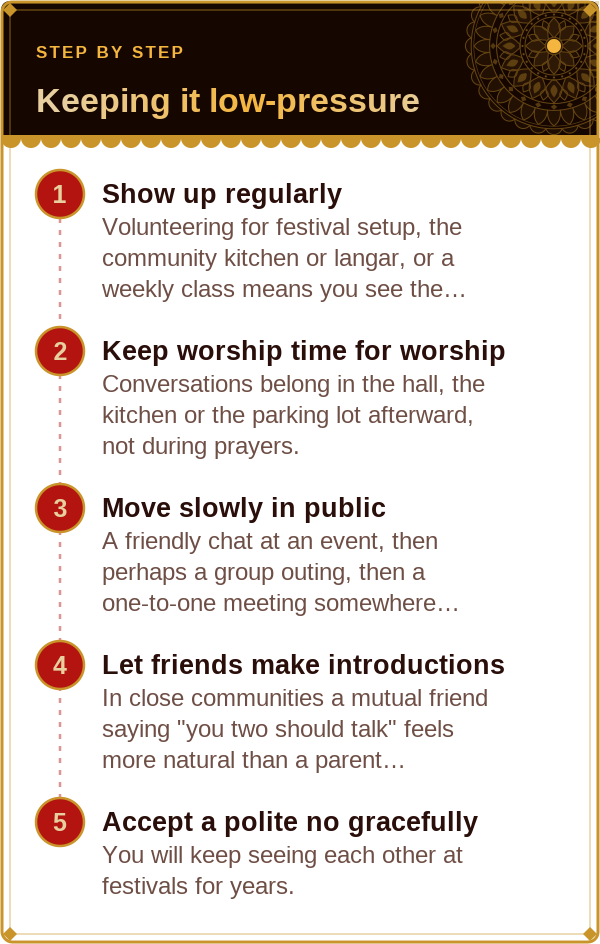
- Show up regularly. Volunteering for festival setup, the community kitchen or langar, or a weekly class means you see the same people often enough for conversations to grow on their own.
- Keep worship time for worship. Conversations belong in the hall, the kitchen or the parking lot afterward, not during prayers.
- Move slowly in public. A friendly chat at an event, then perhaps a group outing, then a one-to-one meeting somewhere ordinary. Group settings take the pressure off both of you.
- Let friends make introductions. In close communities a mutual friend saying "you two should talk" feels more natural than a parent arranging a meeting.
- Accept a polite no gracefully. You will keep seeing each other at festivals for years. Keep it kind.
When to involve family
There is no single right moment, but a few patterns work well for desi dating in DFW households. Many couples wait until both are sure they want something serious, then each tells one trusted relative, often a sibling, cousin or aunt, who can help plan how to tell parents. Families tend to respond better when they hear it from you, calmly, than through community gossip. If both families are from the same tradition, parents may want to meet quickly; if they are from different regions, castes, languages or faiths, give them time to ask questions. The post on what to do when parents disagree with a match covers the harder conversations, and holiday family questions for single desis in DFW offers some lighter preparation for the festival-season interrogation.
Consent comes first
Community introductions sit on a spectrum from "we met at the temple and liked each other" to "our families decided." Arranged introductions where both people freely agree are a long tradition. Pressure, threats or control are not. If you feel you cannot say no to a match, read the Tahirih Justice Center's explanation of forced marriage, which describes help available in the US, and call emergency services if you are in danger.
Where a reading fits
For many families, a chart comes up once things turn serious. A family relationship reading can help when the difficulty is less about the couple and more about parents, in-laws or siblings: who expects what, where tension tends to build, and what is yours to change. Once an engagement is on the table, kundli matching is the traditional step, and the post on matching for Southlake, Keller and Irving families looks at how local families approach it. Sessions run by phone, WhatsApp or video, scheduled in Central Time, so they do not need to happen anywhere the wider community will notice.
What a reading cannot do
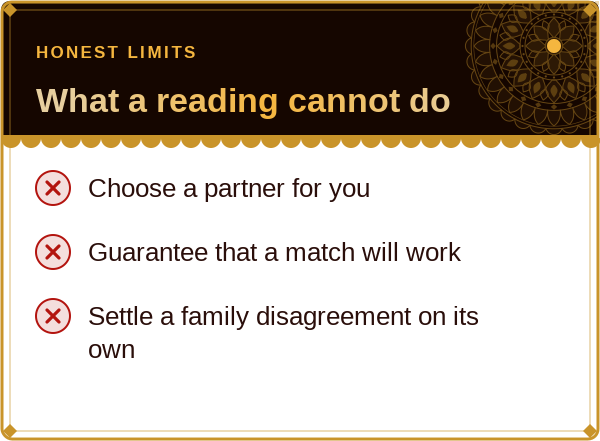
A chart cannot choose a partner for you, guarantee that a match will work, or settle a family disagreement on its own. It is faith-based guidance, one voice in a conversation that belongs to the two of you and the people who love you. Astrologer and Psychic Vijayram will always put both people's consent ahead of any chart result.
Common questions
Is it appropriate to approach someone at a temple or gurdwara?
A friendly conversation at a community event, a class or while volunteering is normal. Keep worship time for worship, avoid anything that feels like pursuit, and let a second conversation happen naturally rather than pressing for a phone number.
When should we tell our families?
Many couples wait until both are sure they want something serious, then tell one trusted relative first. Telling families too early can turn a quiet friendship into a public decision before either of you is ready.
Do we need kundli matching if we met through community?
That is a family choice. Some families want it before an engagement; others do not. If you do it, treat the result as one input among many, and talk openly about values, money, children and where you will live.
What if my parents push me toward someone from the community I do not want to marry?
You have the right to say no. Explain calmly, ask a trusted relative to support you, and if the pressure turns into threats or control, contact the Tahirih Justice Center's forced marriage team or call emergency services in danger.
Related service

Keep reading

Love After 50 in Fort Worth: Dating Once the Kids Have Grown
Dating after 50 in Fort Worth for widowed, divorced or long-single readers: readiness, adult children's reactions, timing in the chart and local ways to meet.
Read article →
Compatibility When One Partner Works Nights at DFW Airport
A shift work relationship guide for Fort Worth couples where one partner works airport or logistics nights: what the charts suggest and routines that help.
Read article →
Mantra and Prayer for Your Own Love Life: A Home Routine
A mantra for your love life to say at home in your own words and time: a sankalpa, a Friday Shukra mantra and family prayers for marriage, timed for Fort Worth.
Read article →Quick answers
Will you read my ex's birth chart without their consent?
No. Your ex's birth chart is not read without their consent. Why a Fort Worth breakup reading focuses on your own chart, and what it can show you instead.
Read answer →Can a love reading help after I have been ghosted?
A love reading can help after you have been ghosted by sorting out your own feelings and next steps. It cannot explain the other person's silence for them.
Read answer →Talk to Astrologer and Psychic Vijayram
Tell us what you are facing. If a reading is unlikely to help, you will be told that plainly.