
Signs of a Soulmate in the Chart: Myth and Meaning
Soulmate astrology, in the Vedic tradition, is less about one perfect person and more about karmic ties: bonds carried from past actions that bring certain people into your life to share lessons. Chart factors such as Rahu and Ketu, the seventh lord and the navamsa are read for these ties. None of them identifies a single destined partner.
Key takeaways
- The word itself is relatively recent in English.
- Hindu thought frames relationships through karma, the principle that actions carry consequences across lifetimes; the overview of karma in Hinduism explains its main forms.
- Because the karmic view includes everyone close to you, family relationships are part of the same picture.
- Instead of "where is my soulmate?", try "what kind of partnership am I ready for, and what do I keep repeating?" That question has answers you can act on.
In Plato's Symposium, the comic poet Aristophanes tells a strange story. Humans were once double creatures, with four arms, four legs and two faces, until the gods split them in half. Ever since, each half has searched for its other. The Jowett translation of the Symposium is still worth reading, and the speech is often named as an early root of the modern idea of a soulmate. Soulmate astrology in the Vedic tradition tells a different story, and in many ways a kinder one.
Where the soulmate idea comes from
The word itself is relatively recent in English. The history of the soulmate idea traces it through Plato, later religious writing and Romantic poetry to the modern belief in one perfect partner who completes you. That belief is powerful and comforting. It can also be heavy. If there is only one right person, every disappointing relationship becomes a failure to find them, and every difficulty with a partner raises the fear that they were not the one.
The Vedic view: ties, not halves
Hindu thought frames relationships through karma, the principle that actions carry consequences across lifetimes; the overview of karma in Hinduism explains its main forms. Many families use the word rinanubandhan, roughly "the bond of debt", to describe why particular people come into our lives: we owe them, they owe us, and the relationship is where the account is settled.
In this view you do not have one soulmate. You have many karmic ties. A parent, a sibling, a close friend, a teacher, a spouse and even a difficult colleague may all be part of the same web. Some ties are sweet and lifelong. Some are short and painful. All of them teach.
Myth and meaning, side by side
| Myth | Meaning |
|---|---|
| There is one perfect person for you somewhere. | Several people may form deep bonds with you. The partner you choose and commit to becomes significant through that choice and the life you build. |
| A soulmate relationship is easy. | Karmic ties often bring lessons, and lessons can be uncomfortable. Ease is welcome, but it is not proof. |
| Intense attraction means destiny. | Intensity often signals a strong karmic contact, which can be either nourishing or draining. Time and conduct show which. |
| If it ends, it was not real. | A tie can be real and still complete. Some bonds are meant to teach and then release. |
Chart signs readers point to
When astrologers look for karmic ties between two people, they commonly examine:
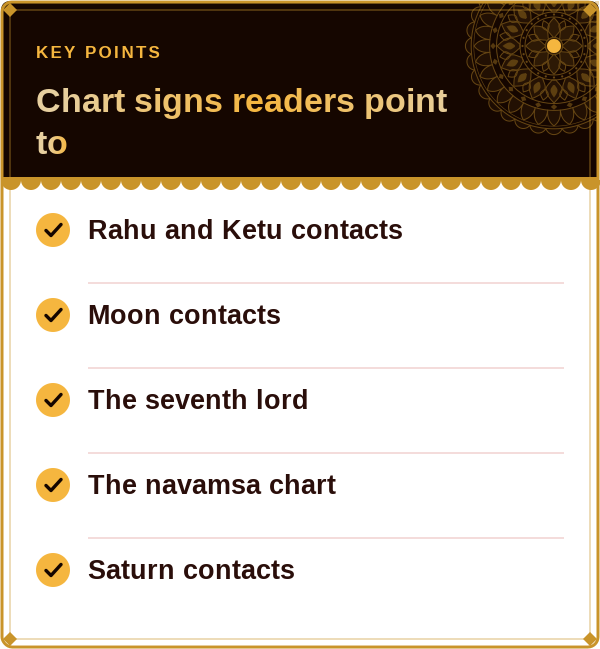
- Rahu and Ketu contacts. The lunar nodes are linked with karma and unfinished business. One person's planets falling on the other's nodes often feels fated, for better or worse.
- Moon contacts. One person's Moon touching the other's Sun, Moon, Venus or ascendant can bring immediate emotional recognition.
- The seventh lord. Where the lord of the partnership house sits, and whether it connects with the other person's chart.
- The navamsa chart. This divisional chart is closely linked with marriage and inner life; our post on navamsa lagna and vargottama planets explains it further.
- Saturn contacts. Saturn links are often read as lasting, serious, duty-bound ties.
These factors describe the strength and flavor of a connection. They do not crown anyone as "the one".
Karmic ties in the family
Because the karmic view includes everyone close to you, family relationships are part of the same picture. A difficult bond with a parent, a deep friendship with a sibling, or the arrival of a child can be read through the same lens of exchange and lesson. A family relationship reading looks at those ties with the same care as a romantic one, and often helps explain why certain patterns repeat from family into romance.
A more useful question
Instead of "where is my soulmate?", try "what kind of partnership am I ready for, and what do I keep repeating?" That question has answers you can act on. A soulmate reading is built around it: readiness, patterns and timing, without promising a particular person. Our post on what to expect from a soulmate reading in Fort Worth walks through how the session runs, and a compatibility reading compares two charts if you already have someone in mind and they agree.
Astrologer and Psychic Vijayram offers these sessions by phone, WhatsApp or video, in Central Time.
What soulmate astrology cannot do
No chart can prove that a person is your destined partner, promise that you will meet someone, or guarantee that a deep connection will last. It can help you understand the ties already in your life and approach new ones with clearer eyes.
Common questions
Is a karmic relationship the same as a soulmate?
Not quite. In popular use, a soulmate is one ideal partner. In karmic relationship astrology, many people, including family and friends, are tied to you through past actions. Some ties are gentle and lasting, others brief and difficult.
Can a chart show that someone is my soulmate?
A comparison of two charts can show strong connections, such as one person's planets falling on the other's Moon or nodes. It cannot prove that a person is your one destined partner, and no honest reader will claim it can.
What does a soulmate reading actually look at?
It looks at your readiness for partnership, the patterns you bring into relationships, and the periods in your chart traditionally linked with meeting significant people. The focus stays on you, not on promising a particular person.
Are twin flames part of Vedic astrology?
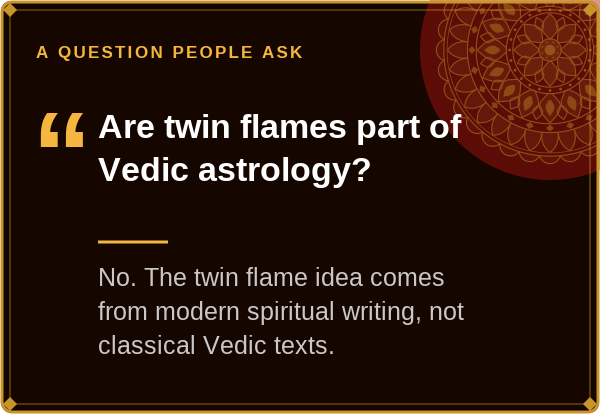
No. The twin flame idea comes from modern spiritual writing, not classical Vedic texts. The closest traditional idea is the karmic bond between souls, which is broader and less romantic.
Related service

Keep reading

Breakup Nights: A Short Evening Mantra Practice When Sleep Won't Come
Spiritual healing after a breakup for the hardest nights: a ten-minute routine of breath, a simple mantra and journaling, plus when to see a doctor about sleep.
Read article →
After an Affair: Questions to Bring Before Deciding to Stay or Go
An infidelity psychic reading cannot confirm an affair, but it can help you think. Questions to bring before deciding to stay or go, with safety first.
Read article →
Waiting for a Partner to Join You in Texas: Patience and Dasha Periods
Long distance relationship astrology for couples waiting on paperwork or a move: how dasha timing is read for reunion questions, with no promised dates.
Read article →Quick answers
Will you read my ex's birth chart without their consent?
No. Your ex's birth chart is not read without their consent. Why a Fort Worth breakup reading focuses on your own chart, and what it can show you instead.
Read answer →Can a love reading help after I have been ghosted?
A love reading can help after you have been ghosted by sorting out your own feelings and next steps. It cannot explain the other person's silence for them.
Read answer →Talk to Astrologer and Psychic Vijayram
Tell us what you are facing. If a reading is unlikely to help, you will be told that plainly.