

Breakup Nights: A Short Evening Mantra Practice When Sleep Won't Come
For spiritual healing after a breakup, a short evening routine helps on nights when sleep will not come: slow breathing, a simple mantra repeated for a few minutes, and three lines in a journal. It calms the mind. If sleep problems last for weeks or you feel hopeless, see a doctor or contact a crisis line.
Key takeaways
- Days after a breakup are full of tasks, people and distractions.
- Do it in bed or sitting on the floor beside it, with the lights low.
- Research on meditation and mindfulness is growing.
- The evening practice works best alongside daytime basics: regular meals, some movement outdoors, time with friends, and limits on checking a former partner's social media.
- A fan's steady sound can double as a focus for the breath.
Before the practice: when to get help. A few rough nights after a breakup are normal. If you are sleeping badly for more than two or three weeks, if you cannot get through work or daily tasks, or if you feel hopeless, talk to your doctor. If you have thoughts of harming yourself, contact the Suicide and Crisis Lifeline now, at any hour, or call emergency services. Do not stop or change any medication without your doctor's advice. Avoid using alcohol to fall asleep; it tends to make sleep worse. The CDC's guidance on sleep and health explains why good sleep matters and when to seek care. With those safeguards in mind, here is a gentle routine for spiritual healing after a breakup.
Why nights are the hardest part
Days after a breakup are full of tasks, people and distractions. Then the lights go off, the phone glows, and the mind replays every conversation. Many people find that healing after a breakup, spiritually or otherwise, comes down to getting through the nights. This routine takes about ten minutes. It will not make the hurt disappear. It gives the night a beginning, a middle and an end, so the mind has something to hold besides the loop.
The ten-minute evening routine
Do it in bed or sitting on the floor beside it, with the lights low. Put your phone on the far side of the room first.
Minutes one and two: settle
Sit or lie comfortably. Notice five things: the weight of your body, the temperature of the air, a sound outside, the feel of the sheet, your own breathing. This brings attention out of memory and into the room.
Minutes three and four: lengthen the out-breath
Breathe in through the nose for a count of four, out for a count of six. Keep it gentle; there is no need to strain. A longer out-breath tends to calm the body. If counting feels like effort, simply let each breath out be a little slower than the one before.
Minutes five to seven: a simple mantra
Choose a short phrase and repeat it quietly, aloud or in your mind, in time with your breath. Mantras have been used this way in Hindu, Buddhist and other traditions for many centuries; the overview of mantra describes their range. Simple options:
- Om Shanti, a prayer for peace, said on each out-breath.
- So Hum, "so" on the in-breath and "hum" on the out-breath, often translated as "I am that".
- A line from your own faith: a short prayer, a name of God, a verse you know by heart.
Twenty-seven repetitions, counted on your fingers or a mala, take about three minutes. When the mind wanders back to the breakup, and it will, notice that and return to the words without judging yourself.
Minutes eight to ten: three lines on paper
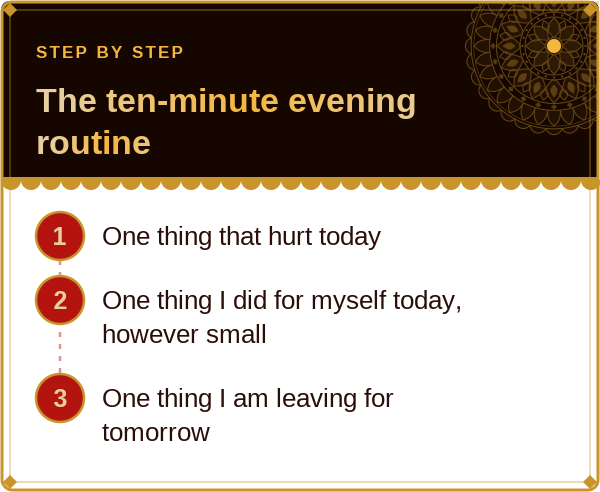
Keep a notebook by the bed and write only three lines:
- One thing that hurt today.
- One thing I did for myself today, however small.
- One thing I am leaving for tomorrow.
The third line matters most. It gives the mind permission to stop working on the problem tonight.
What the evidence says about meditation
Research on meditation and mindfulness is growing. The National Center for Complementary and Integrative Health's summary notes evidence that these practices may help with stress, anxiety and some sleep problems, while also saying they are not a replacement for medical care and are not right for everyone. That is a fair way to see this routine: a helpful habit, not a treatment.
Moving on after a breakup: beyond the night
The evening practice works best alongside daytime basics: regular meals, some movement outdoors, time with friends, and limits on checking a former partner's social media. Our post on the no-contact months looks at the longer stretch after a breakup, with what tends to help at each stage.
If you want a mantra chosen for your chart and faith, personal mantra and meditation guidance can help, and a breakup guidance reading looks at what the relationship meant and the season you are in now. For grief that feels more like mourning, spiritual support in grief offers a gentler space. Astrologer and Psychic Vijayram offers these sessions by phone, WhatsApp or video, in Central Time.
Small adjustments for a Texas summer night
If you are doing this practice in Fort Worth in July or August, when nights can stay very warm, keep the room as cool and dark as you can and drink some water before you start. A fan's steady sound can double as a focus for the breath.
What this practice cannot do
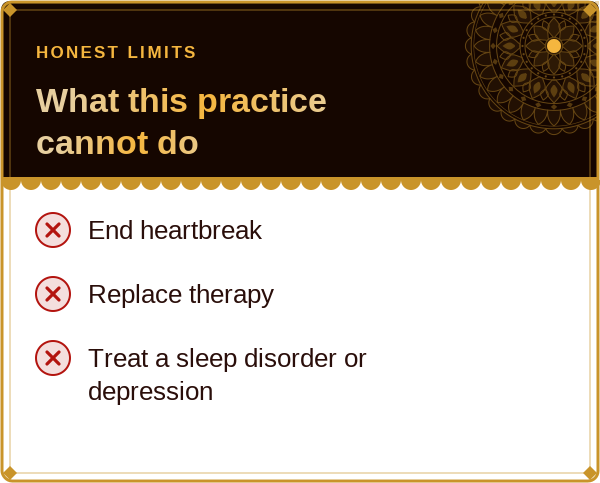
It cannot end heartbreak, replace therapy or treat a sleep disorder or depression. It will not bring anyone back. It is a small nightly kindness to yourself, offered as spiritual support, that sits alongside whatever medical and emotional help you need.
Common questions
Which mantra is best for heartbreak?
A short one you can say without effort. Om Shanti, a prayer for peace, suits many people, and So Hum, linked with the breath, suits those who prefer something quieter. If you have a prayer from your own faith, use that. The words matter less than the steady repetition.
How long before the practice helps?
Some people feel calmer the first night; for others it takes a couple of weeks of repeating it. It is a support, not a treatment. If you are still not sleeping after a few weeks, see your doctor.
Can I do this if I take sleep medication?
Yes, a quiet routine of breath and mantra can sit alongside medication your doctor has prescribed. Never stop or change medication without talking to your doctor first.
What if the practice makes me cry?
That is common and not a sign it is failing. Let the tears come, then return gently to the breath. If distress becomes overwhelming, stop, turn on a light, and call a friend or the Suicide and Crisis Lifeline.
Related service

Keep reading

After an Affair: Questions to Bring Before Deciding to Stay or Go
An infidelity psychic reading cannot confirm an affair, but it can help you think. Questions to bring before deciding to stay or go, with safety first.
Read article →
Waiting for a Partner to Join You in Texas: Patience and Dasha Periods
Long distance relationship astrology for couples waiting on paperwork or a move: how dasha timing is read for reunion questions, with no promised dates.
Read article →
Friends to Partners: Reading the Shift
Friends to lovers astrology: how the eleventh and seventh houses connect in Vedic charts, what a crush reading can say, and why a real conversation wins.
Read article →Quick answers
Will you read my ex's birth chart without their consent?
No. Your ex's birth chart is not read without their consent. Why a Fort Worth breakup reading focuses on your own chart, and what it can show you instead.
Read answer →Can a love reading help after I have been ghosted?
A love reading can help after you have been ghosted by sorting out your own feelings and next steps. It cannot explain the other person's silence for them.
Read answer →Talk to Astrologer and Psychic Vijayram
Tell us what you are facing. If a reading is unlikely to help, you will be told that plainly.