

A Mindful Morning at the Fort Worth Botanic Garden
For a Fort Worth Botanic Garden meditation, arrive near opening, walk slowly through two or three gardens, and let each step and sound be your anchor. The Japanese Garden, with its water and stone, suits a quiet pause. Entry is ticketed and hours change with the season, so check the garden's own site before you go.
Key takeaways
- The garden sits in the Cultural District, a short drive from the museums.
- Walking meditation is simple to describe and surprisingly hard to do.
- Between stations, keep the slow three-part step.
- Some people like a silent mantra as they walk: one repetition per step, or per breath.
- The Japanese Garden reflects Japanese garden design and hosts a Japanese festival in spring and fall.
Some mornings call for more shade and less traffic than a river path can give. A Fort Worth Botanic Garden meditation offers both: paths laid out for slow walking, water you can hear before you see it, and benches placed where people have been sitting quietly for decades. This post describes one way to spend a mindful hour there, moving through a few gardens at a pace slower than feels natural.
A garden with a long history
The garden sits in the Cultural District, a short drive from the museums. It was established in 1934 and is described as the oldest major botanic garden in Texas. Its Rose Garden was built by Depression-era work crews and dedicated in 1933, and the older spring-fed grounds were restored in 2013 as the Tinsley Garden at Rock Springs, replanted with species native to north Texas. Since 2020 the garden has been managed by the Botanical Research Institute of Texas, while the city keeps ownership.
That history matters for a meditation. You are walking paths that thousands of people have used for rest and thought. There is something steadying in that.
Before you go
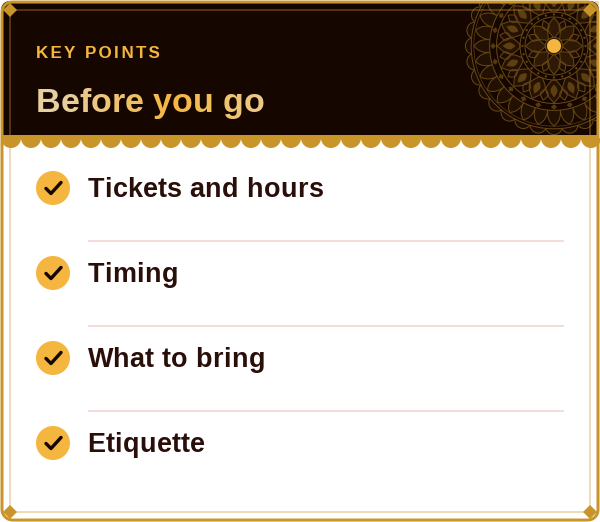
- Tickets and hours. Entry is ticketed, and opening hours, last entry and special-event closures change through the year. Check the garden's website on the morning you plan to go.
- Timing. Arrive close to opening. From late spring through September, the heat builds by late morning.
- What to bring. Water, a hat, comfortable shoes and nothing that beeps. Set your phone to silent and put it away.
- Etiquette. Stay on paths, leave plants untouched and keep your voice low. Some visitors are there to photograph; give them room.
How to walk slowly
Walking meditation is simple to describe and surprisingly hard to do. Break each step into three parts: lift, move, place. Feel the heel, then the sole, then the toes meet the ground. Keep your gaze soft and a few feet ahead. Let your arms hang or clasp your hands loosely in front of you.
Go at about half your usual speed. If someone needs to pass, step aside and let them; that is part of the practice too. When your mind drifts to email or to what you will have for lunch, notice it, and return to the feeling of your feet.
Three slow stations
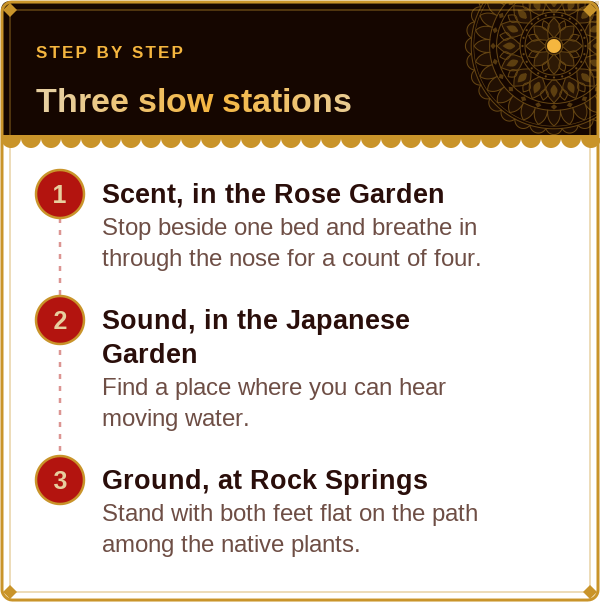
- Scent, in the Rose Garden. Stop beside one bed and breathe in through the nose for a count of four. Notice which scents arrive first and which only come on the second or third breath. Stay for six breaths.
- Sound, in the Japanese Garden. Find a place where you can hear moving water. Close your eyes if it feels safe, or lower your gaze. Listen to the nearest sound, then the farthest, then the space between them. The Japanese Garden is laid out for exactly this kind of attention, with water, stone and careful planting. Stay five minutes.
- Ground, at Rock Springs. Stand with both feet flat on the path among the native plants. Feel your weight settle. Say one line of thanks, in whatever words or faith are yours, before you walk on.
Between stations, keep the slow three-part step. The whole loop can take forty minutes or more.
Adding a mantra, if you like
Some people like a silent mantra as they walk: one repetition per step, or per breath. A short sound such as Om or so hum fits the pace. If you do not yet have a mantra of your own, Astrologer and Psychic Vijayram can help you choose one through personal mantra and meditation guidance, by phone, WhatsApp or video, and show you how to fit it into a walk like this. For a breath practice to pair with the visit, see alternate-nostril breathing step by step.
Respecting the Japanese Garden as a cultural space
The Japanese Garden reflects Japanese garden design and hosts a Japanese festival in spring and fall. It is a public garden, not a temple of any faith, and it is not a stage for anyone's ritual. Quiet attention is welcome. Lighting incense, leaving offerings or chanting aloud is not appropriate there. Keep any devotional practice silent and personal.
Mindfulness in Fort Worth beyond the garden
If the garden suits you, you may like the open air of a sunrise reflection walk on the Trinity Trails, or the prairie quiet of the Nature Center. Living nearby? The page on the Cultural District describes how people there book sessions. For breath-and-mantra work aimed at stress, the energy healing service goes further.
A plain limit
A slow morning among the roses can lift your mood and clear your head, and that is worth having. It does not treat anxiety, depression or any medical condition. If stress is affecting your sleep, work or health, talk to a doctor or counselor, and treat the garden as a companion to that care.
Common questions
Is quiet meditation allowed at the Fort Worth Botanic Garden?
Walking slowly and sitting quietly on a bench are ordinary visitor behavior. If you plan to bring a mat, a group or a speaker, read the garden's etiquette page or ask staff first.
What is the best time of day for a mindful visit?
Near opening, especially from May to September, when the morning is cooler and paths are quieter. Weekdays are calmer than weekends, and special evening events bring large crowds.
Does a regular ticket include the Japanese Garden?
The Japanese Garden sits inside the Botanic Garden grounds, but ticket types and special events change. Check the garden's own website for which areas your ticket includes on the day you plan to visit.
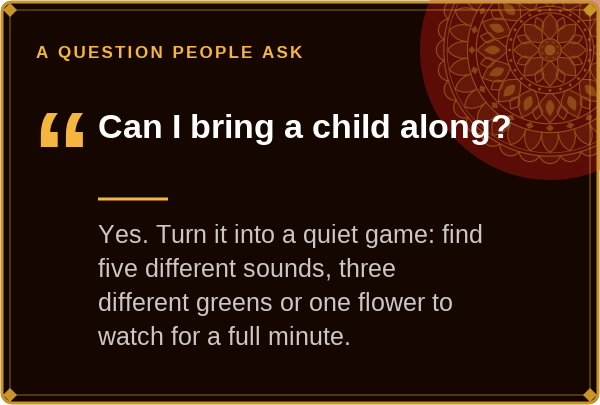
Can I bring a child along?
Yes. Turn it into a quiet game: find five different sounds, three different greens or one flower to watch for a full minute. Children often take to slow attention better than adults expect.
Related service
Keep reading
Sitali Breath and Early Walks for a 100-Degree Fort Worth August
A cooling breath practice for Fort Worth summers: sitali and sitkari breathing, early walks and light food customs, plus the heat-illness signs that need help.
Read article →
Hospice, Shraddha and Goodbyes: Faith Support in Tarrant County
Grief support in Fort Worth with room for faith: bringing Hindu last rites into hospice and funeral plans in Tarrant County, with counseling and crisis lines.
Read article →
Rest for Medical District Night-Shift Workers
A spiritual sleep routine for night shift staff in Fort Worth's Medical District: breath, mantra and a short release ritual after handoff. Not medical advice.
Read article →Quick answers
Can I have spiritual healing while pregnant?
Yes, gentle spiritual healing while pregnant is possible: prayer and mantra only, nothing physical. Keep your obstetrician informed. A Fort Worth answer.
Read answer →Do I need to believe in chakras for a session to help?
You do not need to believe in chakras for a chakra balancing session to help you relax. What a Fort Worth session asks of a skeptic and what it never claims.
Read answer →Talk to Astrologer and Psychic Vijayram
Tell us what you are facing. If a reading is unlikely to help, you will be told that plainly.