

Kundli, Cards or Intuition? Matching the Love Question to the Method
In the love tarot vs astrology choice, your question decides. Astrology suits timing and long patterns, such as when commitment is more likely or how two temperaments fit, and it needs birth details. Tarot suits present feelings and a decision in front of you now, and needs only a clear question. Some sessions combine both.
Key takeaways
- A Vedic chart, or kundli, is calculated from your date, time and place of birth.
- Choose astrology when your question has a long horizon.
- Choose tarot when the question is about now.
- Many sessions use the chart for the long view and the cards for the next step.
- Readings are by phone, WhatsApp or video, booked ahead at a time in Central Time.
Most people who ask about love tarot vs astrology are not really choosing between two belief systems. They have one question that keeps them awake, and they want to know which kind of reading will treat it properly. The short version: the birth chart is built for timing and temperament, the cards are built for the present moment, and intuition works best when it has one of those two to steady it. Here is how to match a love question to the method, using the kinds of questions Fort Worth clients actually bring.
Three methods, three kinds of evidence
A Vedic chart, or kundli, is calculated from your date, time and place of birth. It never changes. What changes is which part of it is active: the planetary period (dasha) you are running and the slow planets moving over it. The overview of Hindu astrology gives the background. Because the chart is fixed, it is good at "what is my pattern?" and "when is this theme stronger?"
Tarot works from a shuffle at the moment you ask. A spread of three to ten cards is laid out and read as a picture of the situation as it stands. Most modern decks borrow their images from the Rider-Waite-Smith deck, and A. E. Waite's own notes on the divinatory meanings show how much of each card is about mood, choice and circumstance rather than dates. That makes tarot good at "what am I feeling, and what am I missing, right now?"
Intuitive or psychic reading draws on the reader's impressions during the conversation. On its own it can drift, so in this practice it is used alongside a chart or a spread, not instead of them.
Tarot or astrology for love: a matching table
| If your question sounds like... | Start with | Why |
|---|---|---|
| When am I likely to meet someone serious? | Astrology | Timing comes from your dasha and the transits over your seventh house |
| Are we compatible for the long run? | Astrology, both charts | Temperament and needs are read from two fixed charts |
| Should I reply to his message after last weekend? | Tarot | A present-moment decision with a short horizon |
| Why do I keep choosing the same kind of partner? | Astrology first, tarot after | The pattern sits in the chart; the cards help with what to do next |
| I am torn between two people | Tarot, sometimes both | A choice spread lays out each path; charts add depth if birth details exist |
| What is she feeling about me? | Neither, reframed | No method reads another person's mind (more on that below) |
When the chart is the better tool
Choose astrology when your question has a long horizon. Marriage timing, recurring relationship patterns, and whether two people's emotional needs fit are the chart's home ground. A love compatibility reading compares both charts side by side: Moon signs for emotional rhythm, Venus for how each person shows affection, Mars for drive and temper, and the seventh house for what each wants from partnership. Families planning an engagement usually want the formal points system as well, and that lives in kundli matching before an engagement, a more structured exercise with its own rules.
The catch is the birth time. If yours is a guess, or you do not know your partner's, say so up front. Moon-sign work still functions without an exact time, as the post on Moon-sign compatibility the Vedic way explains, but house-based timing loses precision.
When the cards are the better tool
Choose tarot when the question is about now. A first date that went oddly, a text you are drafting, a feeling you cannot quite name: these are present-tense, and the cards handle them well. Tarot also suits people who have no birth details, or who simply prefer pictures to planetary periods. A love tarot reading usually runs on a three- to seven-card spread built for the question, and the wording of that question matters more than the deck. Five minutes with the guide to phrasing a tarot question that gets a useful answer will make any session better.
Tarot is weaker for dates. Cards can describe a situation as slow or fast-moving, but a reader who names a month from a spread is stretching the method past what it does well.
Love reading types that combine both
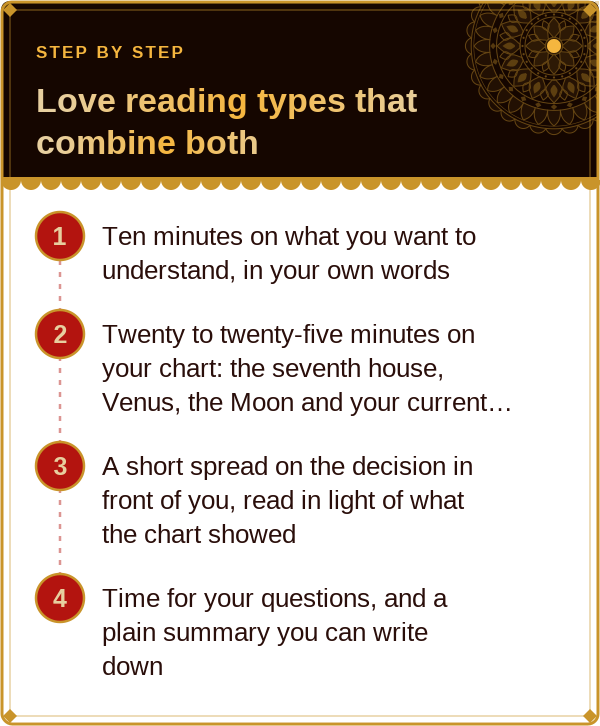
Many sessions use the chart for the long view and the cards for the next step. A combined hour might run like this:
- Ten minutes on what you want to understand, in your own words.
- Twenty to twenty-five minutes on your chart: the seventh house, Venus, the Moon and your current dasha.
- A short spread on the decision in front of you, read in light of what the chart showed.
- Time for your questions, and a plain summary you can write down.
The short answer on whether tarot and astrology can share one session covers the practical side. Some people prefer to split them, booking a chart reading first and a follow-up spread weeks later, so they have time to think in between.
A question no method should answer
"Does he love me?" and "Will she come back?" are the most common love questions of all, and the honest answer is that neither the chart nor the cards can read another person's heart or decide their choices. A careful reader reframes them: what do you need, what are you seeing in their behavior, and what would you do if nothing changed? That is not a dodge. It is the part of the situation you can act on, and it tends to be where clarity comes from.
How sessions run for Fort Worth clients
Readings are by phone, WhatsApp or video, booked ahead at a time in Central Time. For astrology, send your date, time and place of birth beforehand, and your partner's only if they have agreed. For tarot, bring one clearly worded question. If you cannot decide between the two, describe your situation in a sentence when you book and Astrologer and Psychic Vijayram will suggest the method that fits.
What either method cannot do
Neither a chart nor a spread can tell you for certain what will happen in your relationship. Both are faith-based tools for reflection and traditional interpretation. They work best as a prompt for clearer thinking and better conversations, and they are no substitute for talking honestly with the person involved.
Common questions
Which is more accurate for love, tarot or astrology?
Neither is more accurate in general; they answer different kinds of questions. Astrology describes lasting patterns and timing from a fixed birth chart. Tarot describes the present situation from a spread laid out when you ask. Pick the one whose strengths match your question.
Can I get a love astrology reading without my partner's birth time?
Yes, with limits. Your own chart can be read fully, and your partner's Moon sign and planet positions can usually be worked out from the date alone. House-based timing for them will be approximate, and the reader should say so.
Is a love tarot reading worth it if I already sense the answer?
Often, yes. Many people book tarot not for new information but to see a situation laid out calmly. If the spread mirrors what you already sense, that can make the next step easier to take.
How often should I repeat a love reading?
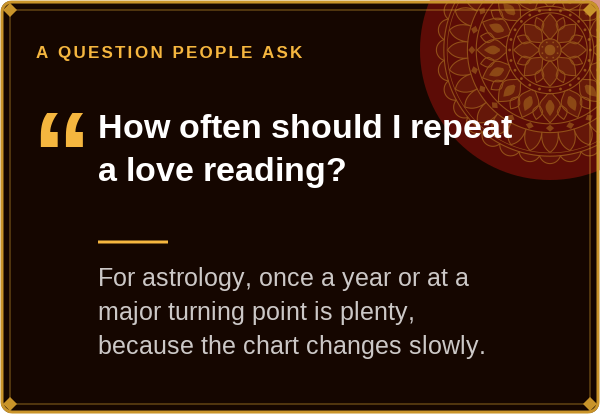
For astrology, once a year or at a major turning point is plenty, because the chart changes slowly. For tarot, give a situation a few weeks to move before asking again. Asking the same question daily tends to feed worry rather than clarity.
Related service

Keep reading

Unhealthy Relationships: When a Reading Should Stop and Help Begin
Unhealthy relationship signs to take seriously, where Fort Worth readers can get confidential help, and why safety comes before any love reading or prayer.
Read article →
Confidence in Dating and the Sun in Your Chart
Self love astrology the Vedic way: what the Sun and your lagna say about self-respect, and small daily practices for dating from steadiness rather than need.
Read article →
What to Expect From a Soulmate Reading in Fort Worth
What a soulmate reading can honestly cover for Fort Worth singles: readiness, patterns and timing in your own chart, what it cannot say, and questions to bring.
Read article →Quick answers
Can we do a compatibility reading from two different cities?
Yes, a compatibility reading works when you live in two different cities: one video call, both partners on screen, and the time confirmed in each zone.
Read answer →Will you read my ex's birth chart without their consent?
No. Your ex's birth chart is not read without their consent. Why a Fort Worth breakup reading focuses on your own chart, and what it can show you instead.
Read answer →Talk to Astrologer and Psychic Vijayram
Tell us what you are facing. If a reading is unlikely to help, you will be told that plainly.