
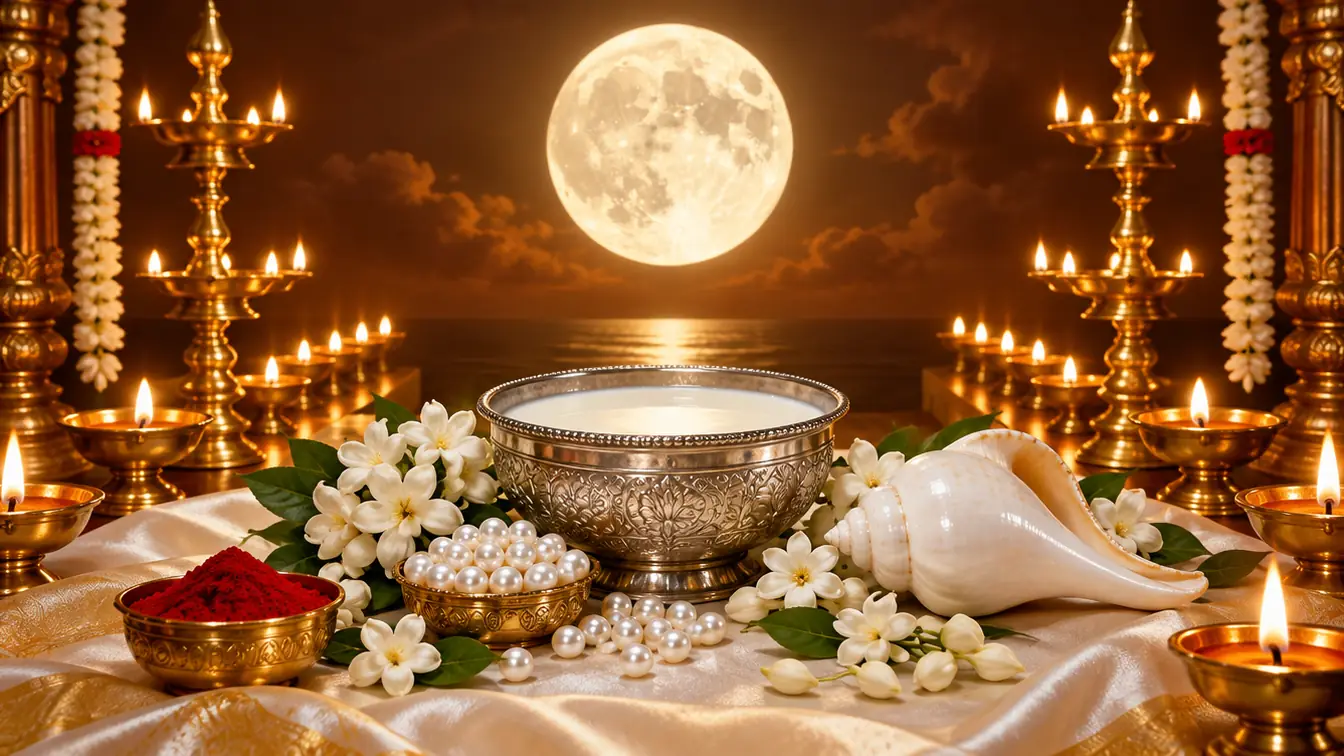
Moon (Chandra) in the Vedic Birth Chart
In Vedic astrology the Moon, Chandra, signifies the mind, emotions, memory, comfort and the mother. Its strength is judged mainly by its brightness (waxing or waning), its sign (exalted in Taurus, weakest in Scorpio), its house and the planets beside or aspecting it. These describe emotional style and needs, not whether a person is good or bad.
Key takeaways
- Indian practice leads with the Moon, and for good reasons inside the system:
- In the myths gathered in the overview of Chandra , the Moon god is linked with soma, the nectar of the gods, and rides across the night sky in a chariot drawn by white horses.
- None of these checks labels the Moon, or you, as good or bad.
- A Moon sign gives the flavor of the mind; the placement checks above describe its strength and setting.
- Tradition reads the mother from the Moon and from the fourth house.
Watch the Moon for a week and it is easy to see why ancient sky-watchers built a calendar around it. It moves against the stars by roughly its own width every hour and comes back to the same background stars in about 27 days. Jyotish divides that circuit into 27 nakshatras, roughly one lunar mansion for each day of the Moon's trip around the sky. The Moon in Vedic astrology, Chandra, is the fastest-moving graha and, for most readers, the most personal one: it stands for the mind.
Why Jyotish puts the Moon first
Western horoscopes lead with the Sun. Indian practice leads with the Moon, and for good reasons inside the system:
- Your rashi, the sign people in India mean when they ask yours, is the Moon sign.
- Your birth nakshatra is the Moon's nakshatra, and it sets the order of your dasha periods.
- Transits such as Sade Sati are counted from the Moon.
- Many readers check the houses twice, once from the rising sign and once from the Moon.
The Moon describes how life is felt from the inside, and a chart without it would be a skeleton without a pulse.
What Chandra signifies
In the myths gathered in the overview of Chandra, the Moon god is linked with soma, the nectar of the gods, and rides across the night sky in a chariot drawn by white horses. In the chart he governs:
- The mind, moods and emotional reactions
- Memory, habits and the sense of comfort
- Sleep and rest
- The mother, nurturing and the home
- The public, popularity and how easily you connect with people
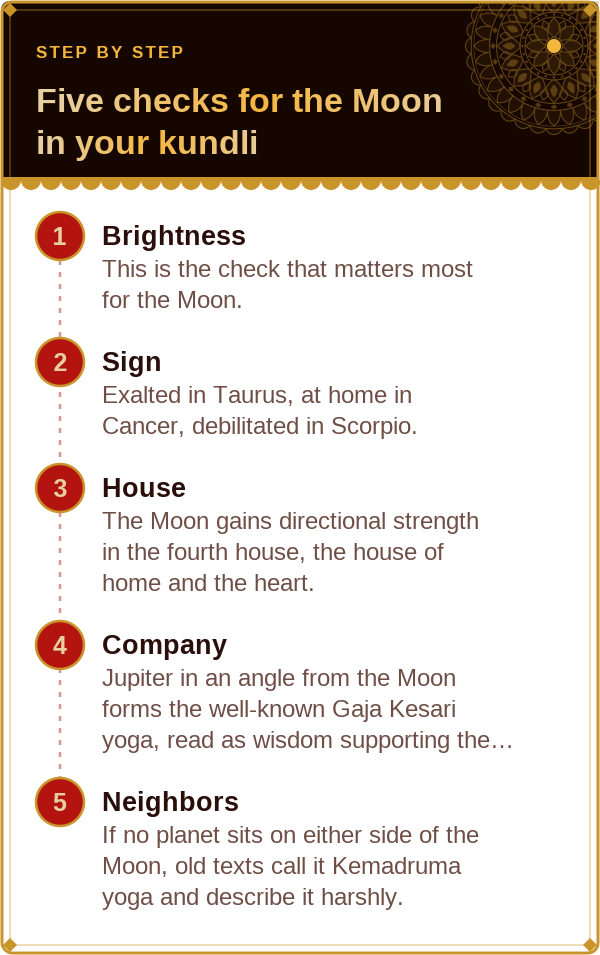
Five checks for the Moon in your kundli
- Brightness. This is the check that matters most for the Moon. A Moon close to the Sun, around the new moon, is called kshina, thin, and treated as weaker; a Moon far from the Sun, near full, is bright and stronger. Look at the distance between the two in the chart.
- Sign. Exalted in Taurus, at home in Cancer, debilitated in Scorpio. The Moon is unusual in having no planetary enemies in the classical scheme; it treats every graha as a friend or a neutral.
- House. The Moon gains directional strength in the fourth house, the house of home and the heart. In the sixth, eighth and twelfth it is traditionally described as working harder for its comfort.
- Company. Jupiter in an angle from the Moon forms the well-known Gaja Kesari yoga, read as wisdom supporting the mind. Saturn with the Moon tends to add seriousness and caution; Rahu with it, restlessness.
- Neighbors. If no planet sits on either side of the Moon, old texts call it Kemadruma yoga and describe it harshly. They also list many cancellations, and modern readers treat it, at most, as a sign that a person does well to build support around themselves.
None of these checks labels the Moon, or you, as good or bad. They describe how easily the mind settles and what helps it.
From Moon sign to Moon placement
A Moon sign gives the flavor of the mind; the placement checks above describe its strength and setting. Someone with a bright, exalted Moon in the fourth house and someone with a thin Moon in the same sign in the twelfth will share a temperament but live it very differently. The posts on the twelve signs, from the exalted Taurus Moon to the debilitated Scorpio Moon, cover the sign side in detail, and the Cancer Moon shows the Moon in its own sign.
The Moon and the mother
Tradition reads the mother from the Moon and from the fourth house. That reading is about the bond, the kind of care given and received, and the emotional inheritance of a family. It is never a forecast of a mother's health or lifespan, and no honest reader offers one.
Moon mahadasha: ten years of the heart's priorities
In the Vimshottari scheme the Moon's major period lasts ten years. It tends to turn attention toward home, family, emotional life and dealings with the public. People often move house, deepen family ties or change how they look after themselves during it. What it means in a given chart depends on what the Moon rules from the lagna and how bright and supported it is. The post on the sub-periods inside a dasha shows how those ten years divide into smaller chapters.
Jealousy and attachment are among the Moon's more delicate themes in relationships; see jealousy, attachment and the Moon.
Looking after the Moon
The most useful Moon remedies are ordinary: regular sleep, regular meals, time near water, and fewer late-night screens. Some families keep Monday, the Moon's day, with a light fast or prayers to Shiva, who wears the crescent Moon in his hair. These are optional devotional choices. A pearl is the traditional stone, but nobody needs one to have a settled mind.
What the Moon cannot tell you
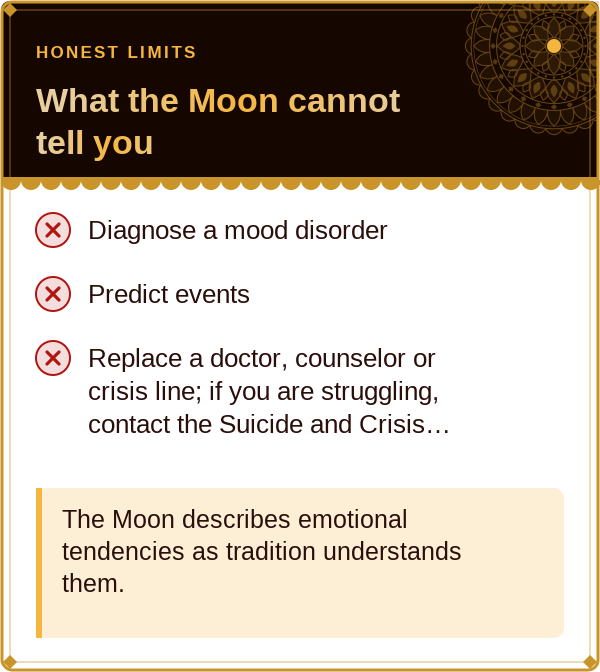
The Moon describes emotional tendencies as tradition understands them. It cannot diagnose a mood disorder, predict events or replace a doctor, counselor or crisis line; if you are struggling, contact the Suicide and Crisis Lifeline. To see how your Moon fits the whole chart, book a birth chart reading with Astrologer and Psychic Vijayram, held by phone, WhatsApp or video at a confirmed Central Time slot.
Common questions
What does a weak Moon in a kundli mean?
Usually that the Moon is thin (close to the Sun), in a difficult house, or pressured by harsh planets. It is read as a mind that needs more rest, routine and support to feel settled, not as a flaw. Many people with a so-called weak Moon are deeply empathetic.
Is the Moon mahadasha a good period?
It depends on the Moon's strength and what it rules in your chart. Commonly it brings home, family, emotional life and public dealings to the front for ten years. A bright, well-supported Moon often makes it a nurturing time; a strained one may ask for more care with rest and moods.
Should I wear a pearl for my Moon?
Pearl is the Moon's traditional stone, but no stone is required and it does not suit every chart. If you are considering one, a gemstone suitability reading looks at the Moon's role in your chart first and explains the choice without any pressure to buy.
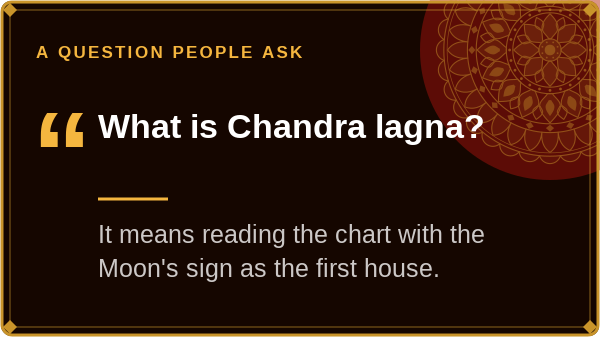
What is Chandra lagna?
It means reading the chart with the Moon's sign as the first house. Many Vedic astrologers check the houses from both the rising sign and the Moon, because the Moon shows how life is felt from the inside. Transits such as Sade Sati are counted this way.
Related service
Keep reading
Mars (Mangal) in the Vedic Birth Chart
Mars in Vedic astrology: what Mangal signifies for energy, courage and conflict, how its strength is judged, the Manglik question, and the Mars mahadasha.
Read article →
Mercury (Budha) in the Vedic Birth Chart
Mercury in Vedic astrology: what Budha signifies for speech, learning and trade, how its strength is judged, combustion and retrograde, and Mercury mahadasha.
Read article →
Jupiter (Guru) in the Vedic Birth Chart
Jupiter in Vedic astrology: what Guru signifies for wisdom, teachers and growth, how its strength is judged, its three special aspects, and Jupiter mahadasha.
Read article →Quick answers
Do I need my birth certificate for a Vedic reading?
You do not need your birth certificate for a Vedic reading in Fort Worth: date, time and place of birth matter, and a certificate simply confirms the time.
Read answer →Can my birth time be worked out from past events?
Birth time unknown? Astrology can estimate it from dated past events through rectification. How it works for Fort Worth clients, and why it stays an estimate.
Read answer →Talk to Astrologer and Psychic Vijayram
Tell us what you are facing. If a reading is unlikely to help, you will be told that plainly.